make preferable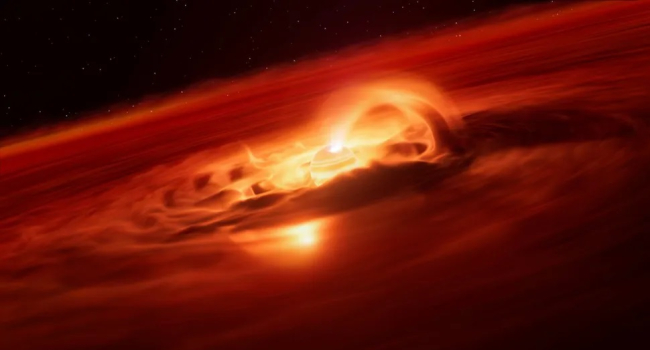
Astronomers have discovered a rare object — the rogue planet Cha 1107-7626, drifting in interstellar space without a parent star. Located in the constellation Chamaeleon about 620 light-years from Earth, this planet, with a mass of 5 to 10 Jupiters, is not just wandering in cold emptiness: it is actively “feeding,” absorbing gas and dust at a record rate. This was reported in a new study published in Nature Astronomy.
“People are used to thinking of planets as quiet and stable worlds, but this discovery shows that free-floating planetary objects can be fascinating places,” said lead author of the study, Víctor Almendros-Abad, an astronomer from the Palermo Astronomical Observatory (INAF, Italy).
Unlike most rogue planets, which are considered cold and dead, Cha 1107-7626 is surrounded by a disk of gas and dust that it actively absorbs. This makes it one of the lowest-mass known free-floating objects with signs of active growth.
Record accretion: 6 billion tons per second
Using the Very Large Telescope (VLT) of the European Southern Observatory (ESO) and NASA’s James Webb Space Telescope (JWST), scientists observed how the planet “captures” material from the surrounding disk. The accretion rate is staggering: 6 billion tons of gas and dust every second. “This is the most powerful accretion episode ever recorded for a planetary object,” emphasized Almendros-Abad.
Observations revealed excess infrared radiation in the 4–12 micron range, silicate features at 10 microns (similar to stars and brown dwarfs), hydrocarbon emission lines indicating a carbon-rich disk, and multiple signs of ongoing growth. These data make Cha 1107-7626 an “ideal example” of disk growth for planetary objects — a true “calling card” of how rogue planets can evolve in the darkness of space.
Growth bursts: how the magnetic field “triggers” the process
The planet does not grow evenly — its “feeding” occurs in bursts, as accretion outbursts. The team used the VLT’s X-shooter spectrograph, JWST data, and archival observations with the SINFONI instrument to capture the object during one such “growth explosion.” Comparing radiation before and during the burst allowed them to reconstruct the process.
It turned out that the bursts are fueled by the planet’s magnetic field — a mechanism previously observed only in stars. Even more surprising: the chemistry of the disk changes during accretion. Water vapor appears only during periods of active absorption, indicating dynamic processes in the object’s environment.
Blurred boundary: planet or star in the making?
The discovery raises a fundamental question about the origin of rogue planets: do they form as the lowest-mass stars, or are they giant planets ejected from their home systems? “This blurs the line between stars and planets and gives us a glimpse into the earliest stages of rogue planet formation,” noted Belinda Damian, an astronomer from the University of St Andrews (UK).
Similar accretion bursts are observed in stellar “nurseries,” suggesting that at least some rogue planets evolve according to a stellar scenario. Co-author of the study Aleks Scholz from the University of St Andrews added: “The idea that a planetary object can behave like a star is awe-inspiring and makes us reflect on what worlds beyond our Solar System may be like in their embryonic state.”
Future: ELT will reveal more secrets
Detecting such objects is difficult due to their faint glow, but the future promises breakthroughs. The upcoming Extremely Large Telescope (ELT) of ESO, with the world’s largest mirror and location under the darkest skies, will allow astronomers to hunt for rogue planets and uncover their “stellar” nature. “This discovery inspires us to reflect on the nascent stages of worlds beyond ours,” concluded ESO astronomer Amelia Bayo.
In short...
The rogue planet Cha 1107-7626 (mass 5–10 Jupiters) in the constellation Chamaeleon, 620 light-years away, absorbs 6 billion tons of gas/dust per second — a record accretion for planetary objects. VLT and JWST detected a disk, magnetic growth bursts, and the appearance of water vapor. This blurs the line between planets and stars, hinting at a stellar formation scenario. ELT will help find more such “cannibals” in space.