make preferable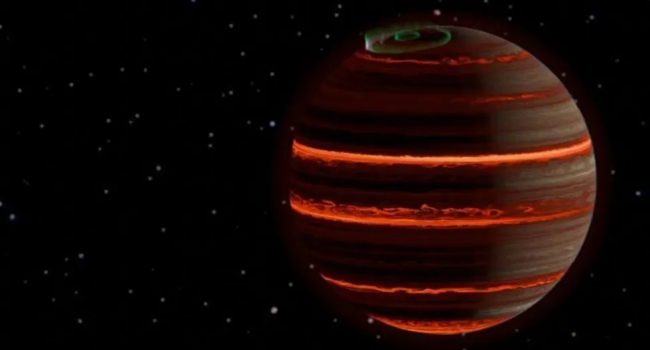
The James Webb Space Telescope (JWST) has delivered the first detailed “weather forecast” for an unusual object — the brown dwarf SIMP-0136, located 20 light-years from Earth in the constellation Pisces. This solitary world, neither a star nor a planet, drifts through space without a sun, glowing with auroras brighter than Earth’s. The study, published on September 26 in Astronomy & Astrophysics, reveals the secrets of its atmosphere, according to space.com.
What is SIMP-0136?
SIMP-0136 is a 200-million-year-old brown dwarf, a “failed star.” Formed from gas clouds, it lacked the mass for nuclear fusion like true stars, and it does not orbit a host star like planets. Instead, it rotates every 2.5 hours and floats freely in space. Its atmosphere became an ideal target for JWST, allowing scientists to track weather changes over a full rotation for the first time.
“These are the most precise measurements ever made of an extraterrestrial atmosphere, and the first time we have directly studied its variations,” said lead author Evert Nasedkin of Trinity College Dublin.
Weather on SIMP-0136: Storms and Auroras
Using JWST’s sensitive instruments, scientists discovered:
- Stable clouds: Contrary to expectations, clouds made of hot silicates (sand-like particles) proved stable rather than patchy.
- A hot atmospheric layer: The upper atmosphere was 300°C hotter than predicted. The cause: powerful auroras triggered by a strong magnetic field. Charged particles collide with the atmosphere, heating it and producing a brilliant glow.
- Temperature fluctuations: In deeper layers, variations of about 5°C were detected, likely caused by giant storms resembling Jupiter’s Great Red Spot.
“The auroras on SIMP-0136 are far stronger than Earth’s, heating the atmosphere,” explained co-author Joanna Voss.
Why does this matter?
Brown dwarfs like SIMP-0136 are not outshone by nearby stars, making them ideal for studying atmospheres. They serve as models for gas giants and exoplanets. JWST data sheds light on how heat and movement within interiors shape the weather of distant worlds.
“Understanding these processes is crucial for studying exoplanets in the future,” added Voss.
What’s next?
The methods used for SIMP-0136 will be applied to exoplanet studies with JWST, the Extremely Large Telescope, and NASA’s upcoming Habitable Worlds Observatory. Scientists aim to explore how weather systems on other worlds evolve over time.
In Short…
JWST has revealed that the brown dwarf SIMP-0136 is home to raging storms and dazzling auroras, powered by its magnetic field and silicate clouds. This is the first detailed observation of an extraterrestrial atmosphere, opening a new path for exoplanet research. A solitary world 20 light-years away has become a key to understanding cosmic weather.