make preferable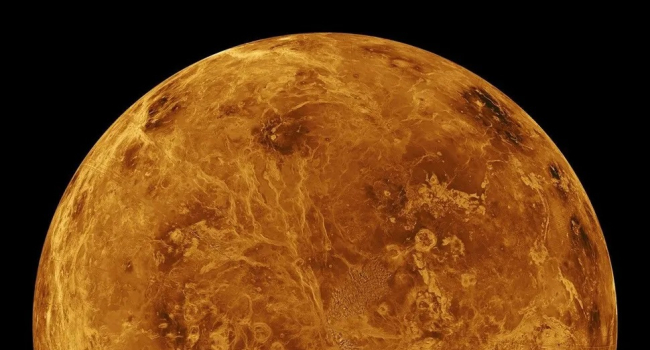
The crown-like geological formations on Venus, known as coronae, have long puzzled researchers. A new study offers an explanation: a “glass ceiling” in the planet’s mantle traps heat, creating convection currents that give rise to these coronae. The findings were reported by Madeleine Kerr, lead author of the study from the Scripps Institution of Oceanography at the University of San Diego, via space.com. The work was published on September 16 in PNAS.
Venus and Earth: Twin Planets with Different Fates
Venus and Earth are “twin planets” in terms of size, density, and distance from the Sun, but their evolution diverged dramatically. Earth has mobile tectonic plates, while Venus is covered by a solid crust on which scientists have identified more than 700 coronae ranging from 124 to over 500 kilometers in diameter. These structures are unique to Venus, and their origin has remained a subject of debate.
The Mantle’s “Glass Ceiling”
The research team, led by Professor David Stegman, proposed that the key lies in a barrier within Venus’s mantle at a depth of 370–460 km, referred to as a “glass ceiling.” This barrier blocks most rising hot plumes, forcing them to spread sideways. Only the largest plumes manage to break through to the surface, forming volcanic uplifts. The rest accumulate into a heat reservoir that produces smaller thermal instabilities.
According to the authors, “This layer of warm fluid at a depth of 600–740 km provides a global source of small-scale plumes.” These plumes, much like wax in a lava lamp, rise, melt, and sink back down, giving rise to the wide variety of coronae.
How Do Coronae Form?
Modeling showed that cold “droplets” of rock from Venus’s crust sink into the hot mantle, triggering a chain reaction. This leads to the rise of numerous small hot plumes, which interact with the mantle and form coronae. The mantle of Venus is between 250 and 400 K hotter than Earth’s, a factor that sustains the process.
Earlier models had to artificially introduce hot plumes, but the new study explains their natural emergence. This marks a step forward in understanding how Venus’s internal heat shapes its surface.
What’s Next?
The researchers acknowledge that further studies are needed, including:
- 3D modeling of plume dynamics.
- Accounting for melting processes on the surface and in the interior.
- Analysis of mantle composition and Venus’s evolutionary history.
These steps will help clarify how long Venus’s mantle remains active and how its coronae and volcanoes are formed.
In Brief…
Venus’s coronae result from a “glass ceiling” in the mantle that traps heat and spawns small plumes, which then create the planet’s unique geological structures. The study reveals how Venus’s internal heat influences its surface, setting it apart from Earth. This brings us closer to solving the mystery of our “twin planet” and its geological past.