make preferable
Scientists at the University of New South Wales (Australia) have taken a revolutionary step in quantum physics: they created entangled states of atomic nuclei, allowing them to interact across distances comparable to the size of modern microchips. The achievement, published in Science, brings us closer to scalable quantum computers that use atomic nuclei as information carriers.
Quantum Entanglement: What Is It?
Quantum entanglement is a phenomenon in which two objects become linked so that a change in one instantly affects the other, regardless of distance. This is the foundation of quantum computing, where information is stored and processed in qubits — the quantum equivalents of bits. Atomic nuclei are ideal qubits because of their stability and resistance to external interference, but their isolation has made interaction difficult.
Atomic nuclei are the cleanest and most isolated quantum objects, but this isolation prevented them from being combined into systems, explained Dr. Holly Stemp, lead author of the study.
How Did Scientists Make Nuclei “Talk”?
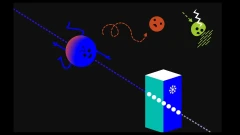
The team solved the problem by using electrons as intermediaries. Unlike nuclei, electrons can “spread out” in space, transmitting quantum information between nuclei separated by about 20 nanometers — roughly 1,000 times thinner than a human hair.
Imagine the nuclei as people standing as far apart as Sydney and Boston. We taught them to communicate through electrons, like speaking on the phone, added Stemp.
This distance is critical: it matches the size of transistors in today’s silicon chips (7–20 nm), making the discovery compatible with the existing semiconductor industry.
Why Is This a Breakthrough?
Until now, engineers faced a dilemma: qubits must be protected from external noise yet also interact for computations. Atomic nuclei are perfect for data storage, but enabling them to “communicate” was the main challenge. The new method makes it possible to:
- Create entangled states between nuclei over distance.
- Integrate quantum systems into silicon chips.
- Use existing processor manufacturing technologies.
We’ve made quantum objects work together on a scale already mastered by microelectronics, emphasized Stemp.
Professor Andrea Morello, a co-author of the study, noted that this removes the main obstacle to scaling up quantum computers based on atomic nuclei. Now, they can be manufactured on the same production lines as modern processors.
What’s Next?
The discovery paves the way for scalable quantum computers that will be:
- More resistant to noise thanks to nuclear qubits.
- Compatible with current manufacturing technologies.
- Capable of performing complex computations beyond the reach of classical computers.
The scientists plan to refine the method by increasing the number of entangled nuclei and testing it in real chips. This could lead to quantum processors that surpass supercomputers in tasks such as modeling, cryptography, and artificial intelligence.
In Short…
For the first time in physics, atomic nuclei have been taught to “communicate” over a distance of 20 nanometers using electrons as mediators. This breakthrough, achieved in Australia, makes nuclear-based quantum computers a realistic goal, fully compatible with modern chips. The discovery brings us closer to a new era of computing, where quantum technologies become part of everyday life.