make preferable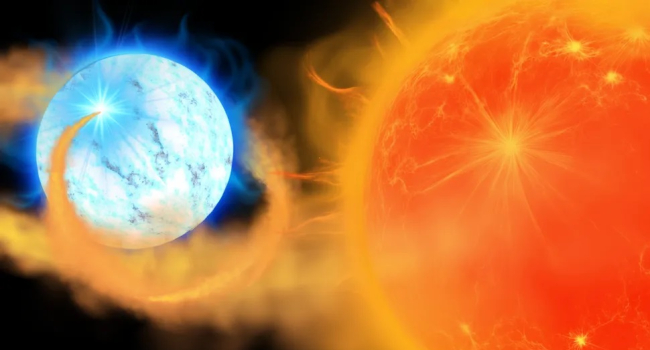
Astronomers have finally solved the mystery of the enigmatic binary star system V Sagittae, which has puzzled scientists since 1902. At its center lies a white dwarf devouring its stellar companion and accumulating so much matter that it is expected to explode as a supernova. The explosion will be so bright that it could be visible even during the day, like a second Moon. The study was published on September 11, 2025, in the Monthly Notices of the Royal Astronomical Society (MNRAS).
The Enigma of V Sagittae: 123 Years of Mystery
V Sagittae is one of the brightest binary stars in the sky, but its behavior has long raised questions. The system consists of a white dwarf — the remnant of a Sun-sized star — and its hot stellar companion, orbiting each other every two days. The white dwarf uses its gravity to steal matter from its companion, but, as scientists have discovered, it cannot process all the material it receives.
Philip Charles of the University of Southampton explained that V Sagittae was not an ordinary system, as it had been the brightest of its kind and baffled experts since its discovery in 1902. He noted that the team’s research showed that this extreme brightness was caused by the white dwarf siphoning material from its companion and turning the stolen matter into a blazing inferno.
How the “Cosmic Cannibal” Works
White dwarfs are “dead” stars — remnants left after their fuel is exhausted. Alone, they simply cool over time, but with a nearby companion, drama unfolds. The dwarf’s gravity pulls gas from the surface of its neighboring star, and due to rotation, the gas does not fall directly onto it but instead forms an accretion disk, swirling like water around a drain. Gradually, material settles on the dwarf’s surface, heating it to millions of degrees.
In V Sagittae, the process has gone too far: the white dwarf is accumulating more matter than it can handle. This leads to thermonuclear reactions on its surface, making the system extraordinarily bright. But the limit is near — the dwarf is approaching the Chandrasekhar mass limit (1.4 solar masses), after which it will explode as a Type Ia supernova, destroying itself completely.
The Giant Gas Halo: Evidence of Overfeeding
Using the Very Large Telescope (VLT) in the Atacama Desert of Chile (at an altitude of 2,636 meters), astronomers discovered a massive gas halo around the system — the result of excess stolen matter. The halo, made of hydrogen and helium, surrounds both the white dwarf and its companion, confirming that the “cannibal” is unable to keep up with the inflow of material.
Pasi Hakala of the University of Turku explained that the white dwarf could not absorb all the mass transferred from its hot partner, which resulted in the formation of the bright halo. He added that the frantic pace and extreme brightness of the doomed system likely signaled its imminent and violent end.
When Will the Explosion Happen?
Soon, V Sagittae is expected to become a nova — a surface flare on the white dwarf that will make the system visible to the naked eye. And within decades or centuries, it will explode as a supernova, shining as brightly as the Moon in daytime. Pablo Rodríguez-Gil of the Institute of Astrophysics of the Canary Islands predicted that when the two stars finally collide and explode, the resulting supernova would be visible from Earth even during daylight.
The system lies 10,000 light-years away, meaning the explosion we will eventually observe has already happened 10,000 years ago. For astronomers, this presents a unique opportunity to study a rare phenomenon in real time.
The Importance of the Discovery
Research on V Sagittae sheds light on the evolution of binary systems and Type Ia supernovae — the “standard candles” used to measure cosmic distances. Such explosions are vital for calculating the expansion rate of the universe, making them central to cosmology. The discovery of the gas halo also refines models of accretion — the process by which stars feed off each other.
In Summary
V Sagittae, a cosmic cannibal devouring its companion, is nearing the point of exploding as a supernova that will be visible in broad daylight. The giant gas halo revealed by the VLT has unlocked the mystery of a system that baffled astronomers for 123 years. This rare spectacle will help scientists study stellar evolution and the supernovae that illuminate the hidden mechanisms of the cosmos. Nature, it seems, favors drama — and V Sagittae is the ultimate proof.