make preferable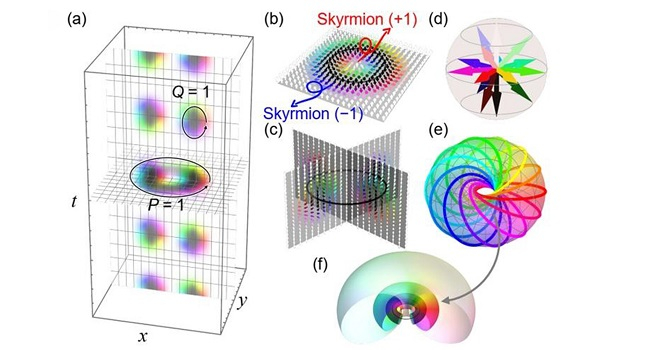
Scientists from Singapore and Japan have introduced a groundbreaking concept of hopfion crystals—light structures that repeat not only in space but also in time, forming unique patterns in space-time. The study was published in Physical Review Letters (PRL).
What Are Hopfions?
Hopfions are three-dimensional topological structures in which quantum properties, such as “spins,” intertwine into closed loops or knots. Previously, they had been observed in magnetic materials and optical fields, but only as isolated objects. Now, for the first time, researchers have demonstrated how hopfions can be arranged into crystalline lattices that cyclically repeat over time.
How Does It Work?
The key to creating hopfion crystals is the use of a two-color light field. When two light beams with different wavelengths overlap, they generate a “pseudospin” that evolves with a specific periodicity. This leads to the formation of a chain of hopfions that emerge in each oscillation cycle of the field. Researchers showed that these structures can be controlled by:
- Adjusting the number of “windings” in a hopfion’s internal loops.
- Switching the sign of the topological charge by changing wavelengths.
In computer simulations, these fields displayed near-perfect preservation of their topological properties, making them highly resistant to external disturbances.
How to Create Hopfion Crystals
The scientists proposed a practical setup for generating three-dimensional hopfion crystals using an array of emitters, such as:
- Dipole antennas.
- Optical lattices.
- Microwave sources.
These devices can produce a precise space-time pattern that remains stable even under external influences.
Applications and Prospects
Hopfion crystals open up new opportunities in multiple fields:
- Magnetic electronics: topological structures are already applied for dense and reliable data storage.
- Optical technologies: hopfions may enable new methods of encoding information and creating stable communication channels.
- Light-matter interactions: these structures could advance techniques for trapping atoms and molecules.
- Quantum optics: hopfions might improve the accuracy of optical systems and sensors.
“This work demonstrates how light can be organized into complex, stable structures that exist simultaneously in space and time,” the authors noted. “It paves the way for new technologies that once seemed impossible.”
In Brief
The creation of hopfion crystals marks a breakthrough in the physics of light and topological structures. Scientists from Singapore and Japan have shown how a two-color light field can form stable knot-like lattices that repeat across space and time. These structures promise revolutionary advances in optics, electronics, and quantum technologies—from data storage to ultra-precise sensors. Hopfion crystals represent a step toward future technologies where light itself becomes a tool for controlling matter at a fundamental level.