make preferable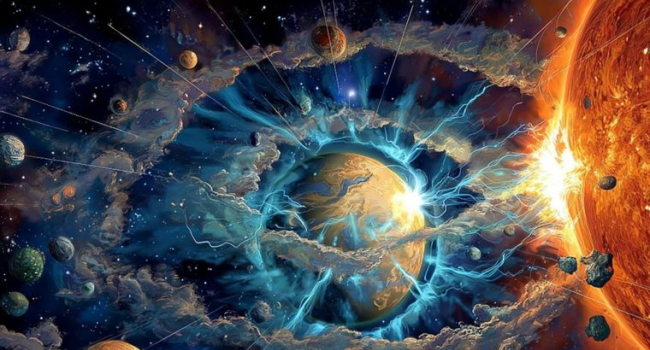
A new study conducted by researchers at the German research center Helmholtz-Zentrum Dresden-Rossendorf (HZDR) suggests that planets in the Solar System — Venus, Earth, and Jupiter — may play a key role in reducing solar activity compared to other Sun-like stars. This, in turn, lowers the likelihood of powerful solar storms capable of disrupting modern technologies on Earth. The findings were published on August 6, 2025, in the journal Solar Physics.
Planets as the Sun’s “Regulators”
Scientists propose that solar flares, magnetic storms, and bursts of radiation are shaped not only by internal stellar processes but also by the gravitational forces of Venus, Earth, and Jupiter. These forces act as a kind of “pacemaker,” synchronizing the Sun’s internal magnetic processes with its regular 11-year cycle.
“This effect is crucial because the Sun is most active when its magnetic field is at maximum strength,” explained lead author Frank Stefani, a physicist at HZDR’s Institute of Fluid Dynamics. “That is when the most intense events occur — such as the Carrington Event of 1859, when auroras were visible as far south as Rome and Havana, and high currents damaged telegraph lines.”
A storm of similar magnitude today could disable satellites, communications, and power grids worldwide. However, the study suggests that the structure of our Solar System helps to reduce the likelihood of such catastrophes.
“If the Sun’s magnetic field remains at lower levels for long periods, the chances of extremely strong events diminish,” Stefani added.
The Role of Planetary Synchronization
The researchers’ model shows that roughly every 11 years, the tidal forces of Venus, Earth, and Jupiter align “in a highly coordinated manner,” influencing the Sun’s magnetic dynamo — the mechanism that generates its magnetic field. This creates rhythmic interactions that stabilize solar activity.
They also investigated a lesser-known cycle: the quasi-biennial oscillation (QBO), lasting about 1.7 years. Their calculations revealed that this cycle matches observed solar patterns and may further moderate stellar activity.
“We consider this phenomenon a promising candidate to explain why solar activity is so much weaker than that of other Sun-like stars,” the researchers wrote.
The Sun — a “Calm” Star
Currently, the Sun is at the peak of its 11-year cycle, as reflected in the increased number of sunspots, flares, and bright auroras on Earth. Yet even the strongest solar outbursts are 10 to 100 times weaker than those of similar stars in the galaxy. This makes the Sun unusually “quiet” compared to its stellar peers.
The study suggests that this subdued activity may have been crucial for the emergence of life on Earth. Unlike highly active stars, which bombard planets with intense radiation and charged particles, the Sun provided a more stable space environment, protecting Earth from extreme radiation.
Limitations and Future Directions
The scientists acknowledge that their model is not yet complete. “We are well aware that several pieces are still missing from our ‘synchronization puzzle,’” they noted, inviting theorists and computational specialists to contribute to future research.
Upcoming studies could refine how planetary tidal forces interact with the solar dynamo and explore whether similar mechanisms apply to other star systems with planets.
In Brief…
The new research suggests that Venus, Earth, and Jupiter act as “regulators” of solar activity, dampening it compared to other Sun-like stars. Their tidal forces synchronize the Sun’s magnetic field, reducing the likelihood of extreme solar storms such as the Carrington Event. Published in Solar Physics, the work highlights the uniqueness of our Solar System and its possible role in creating favorable conditions for life on Earth. Scientists continue to investigate how planets and stars influence one another across the cosmos.