make preferable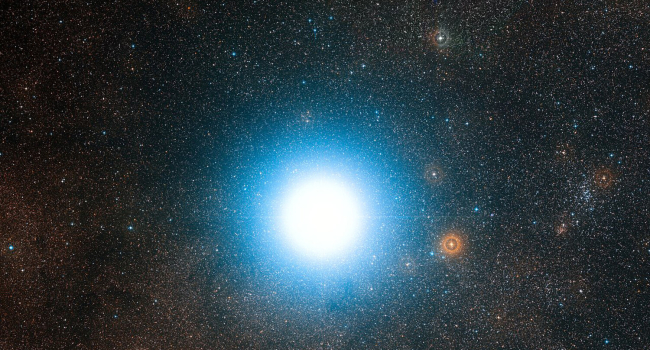
Astronomers have discovered a potential exoplanet in the Alpha Centauri system — the closest star system to Earth, located just 4.37 light-years away. Evgeny Burmistrov, a scientist at Perm National Research Polytechnic University (PNRPU), told Gazeta.Ru why the new object is called a “ghost” and how this discovery changes our understanding of the possibility of life in space.
The Discovery of the Exoplanet: Challenges of Observation
The object was first detected in August 2024 with the James Webb Space Telescope (JWST). Its Mid-Infrared Instrument (MIRI) picked up faint thermal radiation believed to come from an exoplanet located about 2 astronomical units (roughly 300 million km) from Alpha Centauri A. However, the brightness of the system’s stars — Alpha Centauri A and B — complicated the observations, with the planet’s signal being 10,000 times weaker than the starlight.
“To confirm that this was indeed an exoplanet and not a passing asteroid, lengthy studies were needed. Modern instruments made it possible to reduce the brightness of the parent stars and identify an extremely faint signal,” explained Evgeny Burmistrov, an astronomy expert from Perm Polytechnic.
To suppress stellar light, coronagraphic masks were used, blocking out bright radiation and allowing faint nearby objects to be seen. Two scientific papers describing the discovery were published in Astrophysical Journal Letters and are available on the arXiv portal.
Characteristics of the Exoplanet
The detected object is a gas giant with properties close to those of Jupiter:
- Mass: 90–150 Earth masses
- Size: Slightly larger than Jupiter
- Atmosphere: Composed mainly of hydrogen and helium, with no solid surface
- Temperature: Average around −48 °C, making life in the Earth-like sense impossible
The object is located in the habitable zone of Alpha Centauri A — the region where conditions may allow liquid water to exist on celestial bodies. However, being a gas giant, the planet itself is uninhabitable.
“For a long time, it was believed that planets rarely form in binary systems due to gravitational disturbances. But this discovery has overturned those assumptions. It turns out that even in such ‘unstable’ environments, stable worlds can emerge,” noted Burmistrov.
Moons as the Hope for Life
Although the exoplanet itself cannot sustain life, its potential moons are of great interest to scientists. By analogy with Europa (a moon of Jupiter) and Enceladus (a moon of Saturn), which conceal subsurface oceans beneath their icy crusts, the gas giant’s satellites in Alpha Centauri could be located in the so-called “Goldilocks zone” — a region where temperatures allow liquid water to exist. Such conditions make them promising candidates in the search for extraterrestrial life, possibly in microbial form.
Why a “Ghost”?
Follow-up observations in 2025 failed to confirm the presence of the exoplanet — it seemed to have vanished, earning it the nickname “ghost.” Scientists are considering several explanations:
- Starlight interference: The intense radiation from Alpha Centauri A or B may have temporarily obscured the planet, making it invisible to telescopes.
- Orbital motion: The planet may have shifted to a region where its signal is harder to detect.
- Catastrophic event: A collision or gravitational ejection from the system, although this is less likely.
“Most likely, the bright light of the neighboring star makes the planet invisible to telescopes. It is expected to become detectable again in 2026–2027,” Burmistrov explained.
Scientists plan to continue observations with JWST in 2026–2027, when the planet is expected to reappear. This will allow researchers to refine its orbit, composition, and confirm its existence.
Scientific Significance
The discovery carries several important implications:
- Planet Formation: The confirmation of stable planets in binary star systems like Alpha Centauri reshapes our understanding of planetary formation. It may mean that planets are more common in such systems than previously thought.
- Search for Life: The gas giant’s moons become new targets for habitability studies. Future missions, such as the Habitable Worlds Observatory, may focus on detecting biosignatures on such moons.
- Technological Breakthrough: The success of JWST in detecting such a faint signal highlights the power of modern telescopes and coronagraphic technology, which will be crucial for studying other star systems.
In Short…
The detection of the ghost exoplanet in the Alpha Centauri system is a significant achievement made possible by the James Webb Space Telescope. While the gas giant itself cannot support life, its potential moons may conceal subsurface oceans suitable for extraterrestrial organisms. The “ghost” nickname reflects the challenges of observation, but scientists hope to confirm the planet’s existence in 2026–2027. This discovery not only proves that planets can form in binary systems but also opens new opportunities in the search for life in the star system closest to us.