make preferable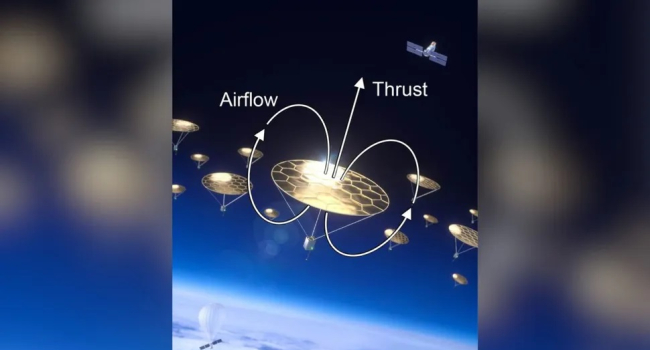
For the first time, scientists have tested tiny devices that use sunlight to fly in conditions close to the near-vacuum of Earth’s upper atmosphere. These lightweight membranes, powered by photophoresis, could revolutionize atmospheric research by enabling the collection of precise data from the so-called “ignorosphere” — the mysterious region between the mesosphere and the thermosphere. The study, published on August 13, 2025, in Nature, opens new opportunities for science and technology.
What Is the Ignorosphere and Why Is It Important?
The ignorosphere is a region of the atmosphere between 50 and 160 km in altitude, spanning the mesosphere (50–85 km) and part of the thermosphere (up to 160 km). It remains poorly studied: too high for planes and weather balloons, yet too low for satellites in low Earth orbit. Data from this zone are only occasionally gathered with sounding rockets, leaving many processes unexplained.
The ignorosphere plays a key role in:
- Space weather: It absorbs energy from solar coronal mass ejections, which can trigger geomagnetic storms, disrupt power grids, and disable satellites.
- Auroras: This is the region where polar lights are formed.
- Satellite reentry: Satellites burn up in this zone upon entering the atmosphere, leaving traces of pollution.
“Accurate data on winds, temperatures, and pressures in this region would greatly improve global climate models,” said lead author Ben Shafer from Harvard’s School of Engineering and Applied Sciences (SEAS).
How Do the Solar Devices Work?
The devices are thin membranes of aluminum oxide coated with chromium, making use of photophoresis. This phenomenon occurs when one side of the membrane heats up more strongly from sunlight than the other, causing gas molecules to push against it and create lift. The effect only works under low-pressure conditions like those found in the upper atmosphere.
In the Nature experiment, researchers made 1 cm membranes levitate in a vacuum chamber under lighting equal to 55% of the Sun’s intensity. “This is an important result proving the technology works under upper-atmosphere conditions,” said Shafer.
For real missions, membranes will need to be larger — about 6 cm in diameter — to carry up to 10 mg of payload, including miniature sensors and antennas. They will be launched from high-altitude balloons at around 50 km, from where they could rise autonomously to 100 km. During the day they stay aloft on sunlight, while at night they descend, but if light enough, they could rise again at sunrise.
Technology and Prospects
Photophoresis was discovered in the 19th century, but practical applications became possible only with advances in nanotechnology and materials science. The idea of using photophoresis for atmospheric research was inspired by theoretical work by David Keith, a former SEAS professor now at the University of Chicago. Keith also proposed using such membranes for geoengineering, reflecting sunlight to cool Earth.
“This is the first time large photophoretic structures have been built and made to fly in the atmosphere,” noted Keith. “It opens up a new class of devices: passive, sunlight-powered, and perfectly suited for upper-atmosphere exploration.”
Shafer and colleague Angela Feldhaus founded the startup Rarefied Technologies to continue experiments and commercialize the technology. Potential applications include:
- Mars exploration: Mars’ thin atmosphere resembles Earth’s mesosphere, making these devices ideal for planetary studies.
- Satellite competition: Outfitted with communication modules, they could provide an alternative to satellite networks like Starlink, with comparable data transmission speeds.
- Climate research: The devices could gather data on winds, temperatures, and pressures, improving climate models.
Challenges and Next Steps
To realize the technology’s full potential, scientists must:
- Reduce membrane weight to increase size and payload capacity.
- Develop navigation systems to keep devices over fixed points on Earth.
- Conduct real atmospheric tests.
Shafer admits that for communications purposes, devices must become much lighter and larger to carry antennas and navigation modules. However, successful lab tests are an important step toward those goals.
In Brief…
Harvard scientists have tested the first devices using photophoresis to fly in Earth’s upper atmosphere, opening the way to studying the ignorosphere — the mysterious region at 50–160 km altitude. Sunlight-powered membranes could carry sensors to collect data on climate, space weather, and even Mars. The study, published on August 13, 2025, in Nature, demonstrates the potential of a technology that may compete with satellites and expand our knowledge of the atmosphere. Startup Rarefied Technologies is already working on commercialization, promising new horizons for science and technology.