make preferable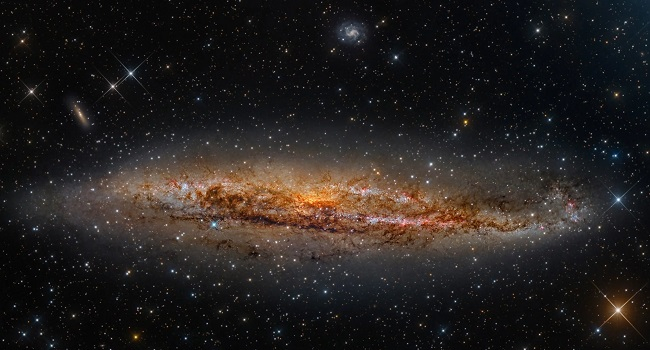
Astronomers have detected an unusual object in the neighboring galaxy NGC 4945 that does not fit into any known category of cosmic phenomena. Named Punctum (from the Latin “point”), this powerful source of radiation was spotted using the Atacama Large Millimeter/submillimeter Array (ALMA). Its unique characteristics have left scientists puzzled, and the discovery may point to a new type of astrophysical object.
Discovery of Punctum
Punctum was found by a team of astronomers led by Elena Shablovinskaya from the Institute for Astrophysical Research at Diego Portales University in Chile. Observations were made in 2023 using ALMA, one of the most sensitive telescopes in the millimeter range. Punctum is located in the spiral galaxy NGC 4945, situated 11 million light-years from the Milky Way—making it a relatively close neighbor.
Characteristics of Punctum
- Brightness: The object is 10,000–100,000 times brighter than typical magnetars, 100 times brighter than microquasars, and 10–100 times brighter than most known supernovae. Among stellar sources, only the Crab Nebula in our galaxy surpasses it in brightness.
- Compactness: Punctum is a small object with a highly organized magnetic field, confirmed by the strong polarization of its millimeter radiation.
- Invisibility in other wavelengths: Punctum has so far been detected only in millimeter radio waves, not in optical or X-ray light.
“Punctum is incredibly bright compared to other objects, except for supermassive black holes,” noted Shablovinskaya.
What Could Punctum Be?
Scientists cannot yet precisely classify Punctum, but suggest that its radiation may be linked to synchrotron emission—a process in which charged particles moving near the speed of light spiral through magnetic fields, emitting radio waves. Possible hypotheses include:
- Magnetar: A highly magnetized pulsar could explain the structured magnetic field, but magnetars are usually much dimmer in the millimeter range.
- Supernova remnant: Objects like the Crab Nebula are bright in millimeter waves, but they are larger, whereas Punctum is compact.
- Unknown type: Punctum may be the first representative of a new class of astrophysical objects previously unnoticed due to telescope limitations.
Shablovinskaya emphasizes:
“Punctum doesn’t fit into any known category. Before ALMA, we simply didn’t have the sensitivity and resolution to detect such objects.”
Why Was Punctum Overlooked?
Punctum is 100 times dimmer than the active nucleus of NGC 4945, which is powered by a supermassive black hole. It was discovered by accident, as ALMA’s observations were aimed at the galaxy’s bright core. The object’s high polarization distinguished it from other sources and drew scientists’ attention.
The object’s brightness did not vary across several 2023 observations, ruling out transient events like flares. However, its invisibility in optical and X-ray wavelengths deepens the mystery. The James Webb Space Telescope (JWST) has not yet observed Punctum in the infrared, which could provide clues about its nature.
What’s Next?
Solving the mystery of Punctum will require further research:
- ALMA: New observations focused directly on Punctum rather than the galaxy’s nucleus could reduce noise and study it across different frequencies.
- JWST: Infrared data could reveal whether Punctum’s emission comes from synchrotron processes, dust, or emission lines—helping to pinpoint its nature.
Shablovinskaya believes Punctum could be either an extreme version of a known object (such as a magnetar in an unusual environment) or an entirely new type of astrophysical phenomenon, overlooked until now due to technological limits.
In Brief
The discovery of Punctum in NGC 4945 is an astronomical puzzle that challenges current understanding. This compact, incredibly bright object—visible only in millimeter radio waves—has a powerful magnetic field and does not match known categories like magnetars or supernova remnants. Its detection highlights the capabilities of modern instruments like ALMA and opens a new chapter in cosmic exploration. Future ALMA and JWST observations may reveal whether Punctum is a unique phenomenon or the first of a new class of cosmic objects.