make preferable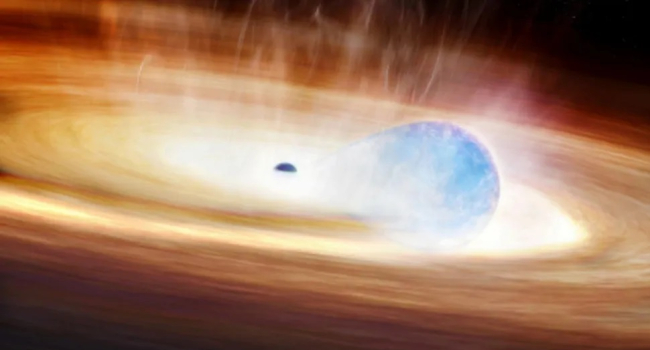
Astronomers may have, for the first time, recorded the explosion of a massive star interacting with a black hole. This discovery, designated SN 2023zkd, was made possible through artificial intelligence (AI), which helped detect the unusual cosmic event in real time. The study, published on August 13, 2025, in the Astrophysical Journal, may point to a new class of stellar explosions. Here’s what makes this event unique and how AI is transforming astronomy.
Discovery of SN 2023zkd
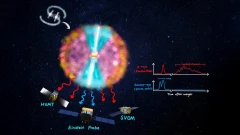
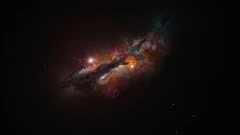
The SN 2023zkd event was first spotted in July 2023 by the Zwicky Transient Facility telescope in California. It occurred in a galaxy with low star formation activity, located 730 million light-years from Earth. A newly developed AI algorithm designed to identify rare cosmic phenomena enabled the detection of the event in real time, giving astronomers the opportunity to begin observations within hours.
“SN 2023zkd shows the clearest signs yet of a massive star interacting with a companion before exploding,” said Ashley Villar, associate professor of astronomy at Harvard University and co-author of the study. She added that this discovery could point to an entire class of “hidden” explosions that AI will help uncover.
What happened to the star?
Initially, SN 2023zkd appeared like a typical supernova—a bright flash marking the death of a massive star, gradually fading over time. However, several months later, astronomers noticed the brightness increasing again. Analysis of archival data revealed that the system had been gradually getting brighter for about 1,500 days (around four years) before the explosion. Such a prolonged pre-explosion stage is extremely rare and indicates strong gravitational influence.
Researchers proposed two main hypotheses:
- Interaction with a black hole: The star was orbiting a black hole whose gravity destabilized it, triggering collapse and explosion. The two peaks in brightness can be explained by the shock wave colliding first with low-density material and later with a dense, disk-shaped cloud of gas ejected by the star earlier.
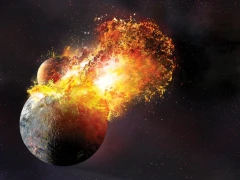
- Destruction by a black hole: The black hole could have torn the star apart before its natural explosion. In this case, the star’s remnants collided with surrounding gas, producing supernova-like luminosity.
In both scenarios, the end result was a more massive black object. “This is the most compelling evidence yet that close interactions can lead to a star’s explosion,” said lead author Alexander Gagliano of the Institute for Artificial Intelligence and Fundamental Interactions.
The role of AI and future research
AI played a critical role in detecting SN 2023zkd by flagging the anomaly in real time. This allowed astronomers to collect data from the earliest moments of the event, something rarely achieved when studying supernovae. Most massive stars exist in binary systems, but catching the mass-transfer phase before an explosion is an exceptional stroke of luck.
In the future, such discoveries are expected to become more common thanks to new tools such as the Vera C. Rubin Observatory in Chile, which will scan the southern sky every few nights. Combining its data with AI systems will make it possible to find and study rare events, revealing how massive stars live and die in binary systems.
“We are entering an era where we can automatically capture rare events at the moment they happen, not just afterward. This allows us to connect the dots between a star’s life and death,” Gagliano emphasized.
In short…
The discovery of SN 2023zkd, made with the help of AI, may be the first evidence of a star’s explosion triggered by interaction with a black hole. Its unique light curves and spectra suggest a new type of stellar explosion in which a black hole plays a central role. AI and new observatories like Vera C. Rubin’s are ushering in an era where rare cosmic events can be studied in real time, deepening our understanding of the life and death of stars. Published in the Astrophysical Journal, this finding highlights how technology is reshaping astronomy, uncovering previously hidden processes in the universe.