make preferable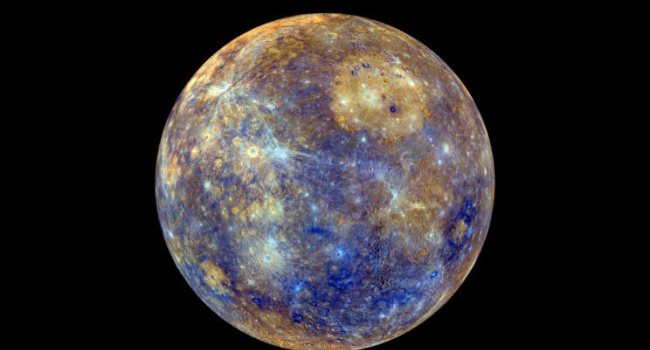
Mercury, the closest planet to the Sun, has shrunk by several kilometers over its 4.5-billion-year history due to cooling. Scientists have developed a new method to refine the estimated scale of this contraction, narrowing the range of previous measurements. The study, published in AGU Advances, sheds light on Mercury’s geological evolution and opens new opportunities for studying other planets.
Why Is Mercury Getting Smaller?
Mercury formed about 4.5 billion years ago, and since then, its interior has been gradually cooling. This process—similar to how a freshly baked pie shrinks as it cools—causes the planet to contract. Cooling creates cracks on the surface, while tectonic faults push up sections of the crust to compensate for the loss in volume. These faults, known as thrust faults or lobate scarps, are key traces of Mercury’s geological activity.
Previous estimates of the planet’s radius reduction ranged from 1 to 7 kilometers, but different measurement methods produced conflicting results, making it difficult to fully understand how the planet changed over time.
The New Method: Precision in Measurement
Geologists Stephan Loveless and Christian Klimczak from the University of Georgia (USA) proposed a new approach to assessing Mercury’s contraction. Instead of analyzing all faults, they focused on the largest one and studied how it “absorbs” the planet’s shrinkage, then scaled the findings to the entire surface. This method produced more precise estimates:
- Contraction from faults: Mercury’s radius decreased by 2–3.5 km.
- Including other cooling processes: Total radius reduction is 2.7–5.6 km.
The new technique not only narrowed the range of estimates but also increased accuracy, providing a clearer picture of the planet’s geological evolution.
Why This Matters for Science
The findings are important for planetary science:
- Understanding Mercury: The refined contraction data help scientists better understand the planet’s internal structure, thermal history, and geological processes. For example, data from the MESSENGER spacecraft (2011–2015) confirm the presence of cooling-related faults and scarps.
- Application to other planets: Loveless and Klimczak’s method can be applied to other celestial bodies with fault systems, such as Mars or the Moon, offering deeper insights into their geological past.
- Comparative planetology: Mercury’s contraction provides clues about processes in the early Solar System and enables comparisons of planetary evolution across bodies of different sizes and compositions.
Context and Outlook
This discovery refines data obtained from NASA’s MESSENGER mission and highlights Mercury’s uniqueness. Despite its small size (about 4,880 km in diameter), the planet shows clear evidence of active geological processes. Researchers hope that future missions—such as BepiColombo, a joint ESA–JAXA project—will bring even more information about Mercury’s surface and interior.
The study’s authors note that their method is universal and could be adapted for analyzing tectonic features on other planets, opening new possibilities for exploring the Solar System.
In Brief…
Over billions of years, Mercury’s radius has shrunk by 2.7–5.6 km due to interior cooling, which caused cracks and faults on its surface. A new method developed by geologists Stephan Loveless and Christian Klimczak has refined the scale of this process, reducing previous uncertainties. The research deepens our understanding of Mercury’s evolution and offers a new tool for studying planets like Mars, demonstrating how modern analysis techniques help uncover the history of the Solar System.