make preferable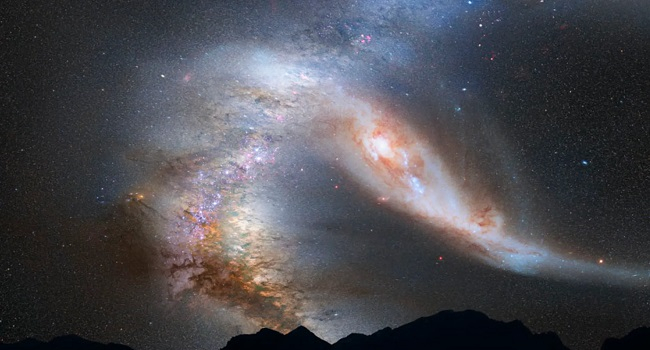
In 2.5 billion years, our galaxy, the Milky Way, will collide with the neighboring Andromeda galaxy and their dwarf satellite galaxies, creating a spectacular cosmic event. Australian astronomers from the University of Queensland, led by Dr. Sarah Sweet, studied a pair of distant spiral galaxies, NGC 5713 and NGC 5719, to understand what this merger might look like. Their research, published in the Monthly Notices of the Royal Astronomical Society (MNRAS), reveals how galaxies interact and form orderly structures.
A Cosmic Dance of Galaxies
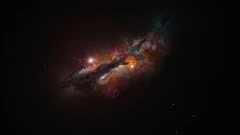
NGC 5713 and NGC 5719, observed as part of the Delegate project, are in the merging stage, about 3 billion years ahead of the Milky Way and Andromeda. These spiral galaxies, surrounded by dwarf satellites, have already begun their “dance,” during which their stars, gas, and dust intertwine under the influence of gravity. Scientists have noticed that the satellites of these galaxies align into ordered planes rather than forming a chaotic cloud, as previously believed.
According to Sarah Sweet, this discovery provides a clear view of how structures similar to the Milky Way’s satellite system form and how they will evolve during the merger with Andromeda. The Milky Way and Andromeda, each with dozens of dwarf galaxies, are moving toward each other at about 110 km/s. In 2.5 billion years, their collision will create a new elliptical galaxy, which scientists provisionally call “Milkomeda.”
The Importance of the Study
The work of Australian astronomers has several key aspects:
- Galaxy evolution: Observations of NGC 5713 and NGC 5719 help model how merging affects star formation, gas distribution, and galaxy structure.
- Dark matter: The interaction of galaxies reveals the role of dark matter, which plays a crucial part in their motion and the formation of satellite systems.
- Cosmic structure: The study refines our understanding of how large-scale structures of the Universe form, including galaxy clusters and walls.
Scientists are also trying to determine whether the history of the Milky Way and Andromeda is unique or typical for spiral galaxies. Comparing them with NGC 5713 and NGC 5719 shows that ordered planes of satellites are a common phenomenon, supporting models of galaxy system formation.
What Awaits the Milky Way?
The merger of the Milky Way and Andromeda will not be catastrophic for stars and planets, as the distances between them are too vast to cause direct collisions. However, gravitational interactions will radically reshape both galaxies:
- Stars will be redistributed, forming a new elliptical galaxy.
- Gas clouds may compress, triggering bursts of star formation.
- Dwarf satellites, such as the Magellanic Clouds, will either merge with the new galaxy or be ejected into intergalactic space.
For humanity (if it still exists 2.5 billion years from now), it will be a spectacular sight: the sky will be filled with the bright stars of Andromeda, and the night view will change forever.
In Conclusion
The study by Australian astronomers sheds light on the future of the Milky Way and Andromeda, which will merge in a “cosmic dance” 2.5 billion years from now. Observations of NGC 5713 and NGC 5719 show how such mergers create orderly satellite systems and influence galaxy evolution. This discovery helps to better understand the role of dark matter and the structure of the Universe, confirming that the Milky Way–Andromeda merger is part of a natural cosmic process. Although this event is billions of years away, it reminds us of the dynamic and ever-changing nature of the cosmos.