make preferable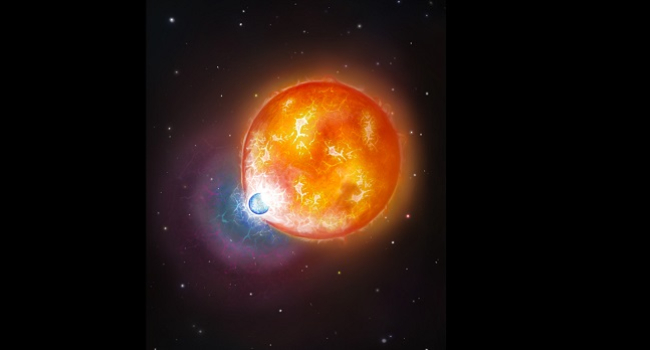
Astronomers from the University of Warwick have discovered a unique celestial phenomenon: the white dwarf WD 0525+526, located 130 light-years from the Solar System, turned out to be not just a fading star, but the result of a colossal collision between two stars. Traces of this cosmic catastrophe were revealed through ultraviolet observations using the Hubble Space Telescope. The study was published in Nature Astronomy.
What Is a White Dwarf?
White dwarfs are compact remnants of stars that have exhausted their nuclear fuel and shed their outer layers. Their size is comparable to that of Earth, but their mass can reach up to half the mass of the Sun. WD 0525+526 stands out even among these objects: its mass exceeds that of the Sun by 20%, making it an “ultramassive” white dwarf — an extremely rare object.
Traces of a Cosmic Collision
“At first glance, this star appeared to be just a heavy white dwarf,” said lead author Snehalata Sahu. “But in the ultraviolet, we detected tiny traces of carbon in its atmosphere. These traces indicate that this is not a typical star, but the result of a merger between two others.”
Normally, carbon in white dwarfs is hidden beneath thick layers of hydrogen and helium. However, during a stellar merger, the outer shells are stripped away, allowing carbon to seep to the surface. In the case of WD 0525+526, the hydrogen-helium layers are ten billion times thinner than those in typical white dwarfs — which explains the presence of carbon.
The Uniqueness of the Discovery
WD 0525+526 stands out even among the rare white dwarfs formed by mergers. The amount of carbon on its surface is 100,000 times less than in other similar objects. “This means the star is at a very early stage of its ‘second’ life — just a moment, by astronomical standards, after the catastrophic merger,” explained co-author Antoine Bédard.
The star is continuing to cool, and its surface will become richer in carbon in the future. However, even now it offers a unique opportunity to study a freshly formed white dwarf, capturing the moment of a stellar catastrophe.
Importance for Astronomy
The discovery of WD 0525+526 gives scientists a first glimpse into the birth of an ultramassive white dwarf immediately after a stellar merger. It confirms the theory that such objects can form through collisions, not only through the evolution of single stars. Ultraviolet observations with the Hubble Space Telescope open new opportunities for studying the composition and history of such stars.
Conclusion
The white dwarf WD 0525+526 is a “posthumous portrait” of an ancient stellar catastrophe, captured in ultraviolet light. Its unusual mass and traces of carbon point to the recent — in cosmic terms — merger of two stars. This discovery not only deepens our understanding of stellar evolution but also showcases how advanced observation technologies help unlock the secrets of the universe. In the future, scientists plan to continue studying similar objects to better understand stellar mergers and their role in cosmology.