make preferable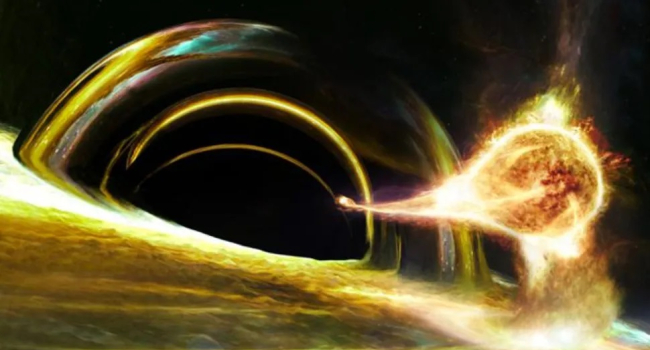
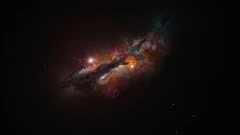
Astronomers have observed a rare and extraordinary cosmic event: a star that survived a destructive encounter with a supermassive black hole — and then returned for a second “round” roughly 700 days later. The phenomenon, named AT 2022dbl, was recorded as two nearly identical bursts of light. The discovery, published on July 1 in Astrophysical Journal Letters and reported by Space.com, marks the first confirmed case of a star surviving partial tidal disruption and returning for a repeat interaction — a finding that forces scientists to rethink the nature of tidal disruption events (TDEs).
What Happened: Two Strikes, One Star
Supermassive black holes — millions to billions of times the mass of our Sun — reside at the centers of most large galaxies. When a star ventures too close, it experiences intense tidal forces that stretch it vertically and compress it horizontally in a process called spaghettification. Typically, this leads to the star being shredded, with some debris falling into the black hole and the rest flung into space.
In the case of AT 2022dbl, astronomers observed two similar light bursts roughly 700 days apart — one in 2022 and the other in 2024. After ruling out the possibility of two separate stars being disrupted, scientists concluded that both flares came from the same star, which had survived the initial encounter and returned for a second pass.
“This is the first time we’ve seen a star survive a brush with a supermassive black hole and come back for more,” said Iair Arcavi, a researcher at Tel Aviv University. The big question now: did the star survive the second “bite”?
Partial Disruption: A New Twist on TDEs
Traditional tidal disruption events involve the total destruction of a star, resulting in a brilliant flare lasting weeks to months as matter spirals into the black hole. But in recent years, astronomers have noted that some TDEs appear cooler and dimmer than expected.
AT 2022dbl offers an explanation — the star may have only been partially torn apart. The team suggests that it orbits the black hole in a stretched elliptical path, with each pass bringing it perilously close. If it survived the second encounter, a third flare is expected in early 2026. If no flare occurs, the second passage may have been fatal — yet the similarity of the two previous flares could still help researchers understand how partial and total disruptions can look nearly identical, a long-held but unconfirmed theory.
Scientific Significance
The case of AT 2022dbl could fundamentally change our understanding of how black holes interact with stars.
“In any scenario, we need to rewrite our models of these flares and what they tell us about the monsters at the centers of galaxies,” Arcavi emphasized.
If partial disruptions are more common than previously thought, this suggests supermassive black holes might not always devour stars in one gulp. Instead, they may “nibble away,” producing a series of periodic flares as the star orbits.
Such events also provide a rare opportunity to study black holes. Because black holes don’t emit light, TDEs are one of the few ways to observe them indirectly. Repeated interactions — like those seen in AT 2022dbl — could yield valuable data on black hole mass, spin, and accretion disk behavior over time.
What Comes Next: Waiting for the Third Flare
Arcavi’s team plans to monitor the region around AT 2022dbl closely, hoping to catch a third flare in 2026. Instruments like the Hubble Space Telescope, James Webb Space Telescope, and advanced ground-based observatories will be used to track any changes in brightness.
If the third flare occurs, it would strongly support the theory of repeat partial disruptions, potentially launching a new subfield in the study of black holes and stellar evolution. If not, scientists will examine the differences between fatal and non-fatal TDEs, advancing our understanding of both.
The discovery also highlights the importance of long-term monitoring of galactic cores. Projects like the Vera C. Rubin Observatory, set to begin operations in 2025, will make it easier to systematically track such rare and dynamic phenomena.
Conclusion
The star behind AT 2022dbl has defied expectations — surviving not one but two encounters with a supermassive black hole. This remarkable resilience challenges established ideas about how stars interact with black holes and opens the door to new models of tidal disruption. With a possible third flare on the horizon in 2026, the astronomical community waits with bated breath. Whether the star survives or not, AT 2022dbl is already reshaping our understanding of black holes and their role in the evolving universe.