make preferable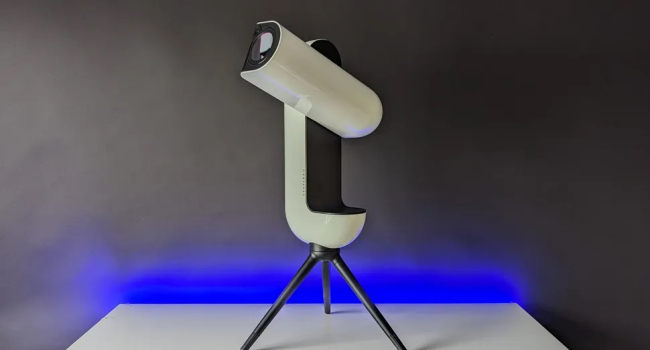
Tabletop telescopes are an ideal choice for both beginner and experienced astronomers who value compactness, portability, and easy setup. They can be placed on any flat surface and allow for immediate star observation. Based on information from Space.com and other sources, here is a review of the best tabletop telescopes of 2025, suitable for different experience levels and purposes—from visual observation to astrophotography.
- Vaonis Vespera II
Best for Astrophotography
Specs:
• Aperture: 50 mm
• Focal Length: 250 mm
• Sensor: Sony IMX585, 8.3 MP
• Battery Life: 4 hours
• Weight: 5 kg
• Field of View: 2.5 x 1.4 degrees
• Storage: 25 GB
Pros:
• Automatic alignment and tracking
• High-resolution sensor (up to 24 MP in CovalENS mode)
• Stylish, compact design
• Controlled via Singularity Wi-Fi app
Cons:
• Short battery life
• Tripod not included (extra $100–149)
• High price ($1590)
Best for: Beginners and advanced astrophotographers wanting to capture nebulas and galaxies like the Orion Nebula (M42) with minimal effort. However, due to its small aperture, it’s less suited for detailed planetary observation, and the high price may deter budget-conscious users.
- Celestron FirstScope 76
Best for Kids
Specs:
• Aperture: 76 mm
• Focal Length: 300 mm
• Sensor: None
• Battery Life: None
• Weight: 1.95 kg
• Field of View: 1.7 degrees (with 20 mm eyepiece)
Pros:
• Ultra-light and easy to use
• Quick, tool-free setup
• Comes with two eyepieces (15x and 75x)
• Affordable ($70)
Cons:
• Limited to basic visual observations
• No automation or tracking
Best for: Kids from age 8 and beginners looking for an affordable telescope to observe the Moon and bright planets like Saturn. While it reveals lunar craters and Saturn’s rings, it’s not suitable for faint galaxies or nebulas. Lightweight and simple design make it perfect for young astronomers, but not for astrophotography.
- Celestron StarSense Explorer 8-inch Dobsonian
Best for Intermediate Users
Specs:
• Aperture: 203 mm
• Focal Length: 1200 mm
• Sensor: None
• Battery Life: None
• Weight: 19.8 kg
• Field of View: 0.8 degrees (with 25 mm eyepiece)
Pros:
• Large aperture for bright images
• StarSense app with access to over 40,000 objects
• Sturdy Dobsonian base
Cons:
• Heavy (19.8 kg)
• Manual operation, no auto-tracking
Best for: Intermediate astronomers wanting detailed views of galaxies, nebulas, and planets. The StarSense app simplifies object location, which is great for those not yet comfortable with star charts. However, the telescope's weight reduces portability, and lack of auto-tracking limits long-exposure astrophotography.
- Celestron StarSense Explorer 130mm Tabletop Dobsonian
Best for Beginners
Specs:
• Aperture: 130 mm
• Focal Length: 650 mm
• Sensor: None
• Battery Life: None
• Weight: 6.9 kg
• Field of View: 1.5 degrees (with 25 mm eyepiece)
Pros:
• Lightweight and portable
• Intuitive navigation with StarSense app
• Fast setup
Cons:
• Manual tracking, unsuitable for long astrophotography sessions
• No auto-targeting
Best for: Beginners seeking an easy-to-use telescope with great views of the Moon, planets, and bright deep-sky objects like the Andromeda Galaxy. The StarSense app helps with object finding, and the 6.9 kg weight supports portability. However, manual controls limit its astrophotography potential.
- ZWO Seestar S50
Best Budget Smart Telescope
Specs:
• Aperture: 50 mm
• Focal Length: 250 mm
• Sensor: Sony IMX462, 2 MP
• Battery Life: 6 hours
• Weight: 2.5 kg
• Field of View: 1.8 x 1.0 degrees
• Storage: 64 GB
Pros:
• Affordable ($499)
• Easy operation via Seestar app
• Long battery life
Cons:
• Low-resolution sensor
• Limited planetary detail
Best for: Budget-minded beginner astrophotographers interested in capturing nebulas and galaxies. Includes tripod and solar filter for added versatility. The automatic tracking and image stacking enhance performance in light-polluted areas. Limited detail due to resolution and aperture.
- ZWO Seestar S30
Best for Compact Astrophotography
Specs:
• Aperture: 30 mm
• Focal Length: 150 mm
• Sensor: Sony IMX462, 2 MP
• Battery Life: 6 hours
• Weight: 1.6 kg
• Field of View: 2.9 x 1.6 degrees
• Storage: 64 GB
Pros:
• Ultra-light and portable
• Very affordable ($399)
• Wide field of view
Cons:
• Very small aperture
• Low image resolution
Best for: Those wanting to start astrophotography on a minimal budget. Wide field of view is ideal for large objects like the Pleiades. Lightweight and travel-friendly. However, the image quality is limited, and it's not designed for visual observation.
So which to choose?
Choosing a tabletop telescope in 2025 depends on your goals and budget. For astrophotography, Vaonis Vespera II and ZWO Seestar S50/S30 offer automation and ease of use. For visual observation, the Celestron StarSense Explorer 130mm or 8-inch Dobsonian are excellent picks, while Celestron FirstScope 76 is perfect for children. All these models balance portability and performance, enabling effortless exploration of stars and planets—including the enigmatic Uranus.