make preferable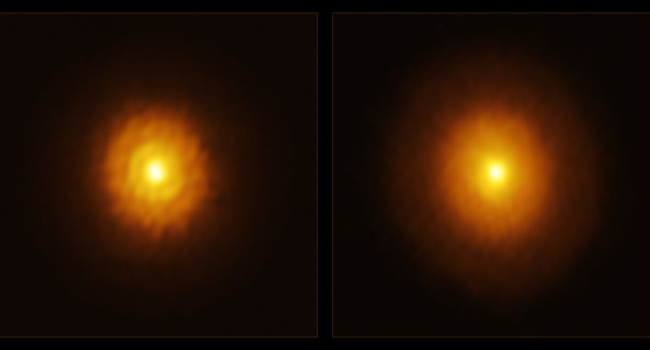
An international team of astronomers has made a remarkable discovery: a giant exoplanet, estimated to be about ten times more massive than Jupiter, has been found within the protoplanetary disk surrounding the young star MP Mus. The discovery, published in Nature Astronomy, challenges existing ideas about how planets form in young stellar systems.
A Surprising Discovery in a “Flat” Disk
The star MP Mus, located several hundred light-years from Earth, is surrounded by a protoplanetary disk—a cloud of gas, dust, and ice. This disk was previously considered uniform, showing no clear signs of planet formation such as gaps or rings, which typically suggest the presence of celestial bodies. Given the star’s young age—only 7 to 10 million years—the absence of these structures puzzled scientists, as planet formation is usually visible at this stage.
The Role of Modern Telescopes
The breakthrough became possible thanks to the combined data from two advanced instruments: the ALMA radio telescope in Chile and the Gaia space observatory of the European Space Agency. For the first time, Gaia managed to detect a planet within a protoplanetary disk. Follow-up observations at longer radio wavelengths with ALMA allowed scientists to probe deeper into the disk, revealing an inner cavity and two outer gaps—hallmarks of a massive object’s presence.
Gravitational Clues and Computer Simulations
Another key to the discovery was the subtle “wobble” of the star MP Mus—slight but measurable motion caused by the gravitational pull of a large orbiting object. By combining ALMA and Gaia data, scientists confirmed that a massive gas planet is indeed hiding within the disk. Computer simulations showed that such a body could account for both the star’s movement and the unusual structure of the disk.
Future Research Outlook
Lead researcher Dr. Álvaro Ribas from the University of Cambridge noted that improvements in ALMA’s capabilities and the upcoming launch of new telescopes such as ngVLA will open new opportunities to study protoplanetary disks. These technologies will help researchers gain deeper insights into the processes of planet formation, including those that shaped our own solar system.
Conclusion
The discovery of a giant exoplanet within the disk of MP Mus marks an important step in understanding planetary formation. It highlights how advanced technologies and international collaboration can uncover cosmic phenomena that were previously hidden from view.