make preferable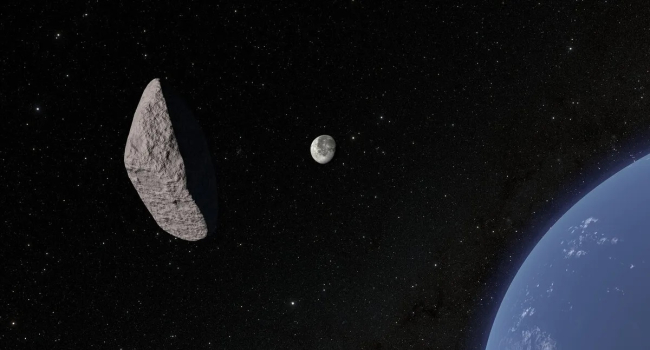
Asteroid 2024 YR4, discovered on December 27, 2024 by the ATLAS telescope in Chile, no longer poses a threat of impacting Earth. However, its potential collision with the Moon in 2032 raises serious concerns for orbital infrastructure. Initially, its Earth impact probability was estimated at 3%, but subsequent observations—including those from the James Webb Space Telescope—ruled out that risk. Now, attention has shifted to the Moon: YR4 has a 4.3% chance of striking the lunar surface on December 22, 2032, possibly generating lunar debris dangerous to satellites and a meteor shower visible from Earth, according to research by Paul Wiegert from the University of Western Ontario, as reported by Space.com.
Asteroid Characteristics and Impact Consequences
Asteroid 2024 YR4 is 53–67 meters in diameter—roughly the size of a 10-story building—and travels at a speed of about 48,000 km/h. If it hits the Moon, the impact energy would equal 6.5 megatons of TNT, comparable to a large nuclear explosion (for comparison, the Hiroshima bomb released about 15 kilotons).
Such a collision would create a crater around 1 km wide, ejecting 10 to 100 million kilograms of lunar material into space. Most debris would fall back to the Moon, but 0.02–0.2% (20,000 to 200,000 kg) could escape lunar gravity. These fragments—ranging from 0.1 to 10 mm in size—would travel at 10 km/s, making them potentially lethal to satellites and stations like the Lunar Gateway.
Satellite Threats
Wiegert estimates that if YR4 strikes, the meteoroid flux around Earth could increase by 10 to 1000 times the normal level for several days. This would be particularly dangerous for satellites in low Earth orbit (LEO), which hosts about 90% of operational satellites, including mega-constellations like Starlink.
Even particles as small as 0.1 mm can cause serious damage to sensors, antennas, or cooling systems—potentially rendering satellites inoperable. “A small problem for a satellite is a big one—because you can’t fix it,” Wiegert emphasizes.
As satellite numbers grow through 2032, the risk exposure increases. The debris could remain in orbit for months or even years, compounding long-term hazards. High-orbit satellites like James Webb at L2 (~1.6 million km from Earth) are relatively safe, but LEO systems are vulnerable.
Safety for Earth and Meteor Shower Potential
For people on Earth, there’s no direct threat: the atmosphere will burn up almost all incoming fragments under 1 meter. However, we might witness an exceptional meteor shower that could last several days and be visible globally.
Due to the relatively slow entry speed (10 km/s), the meteors may appear less bright than typical ones, but the sheer number could make the event visually stunning. Wiegert says it may be the most significant lunar impact in 5,000 years, rivaling the Shoemaker–Levy 9 collision with Jupiter in 1994.
Observers might see the impact flash with the naked eye. Astronomers like Gareth Collins of Imperial College London believe the plume of vaporized material will be visible even during the day, while Daniel Bamberger of the Northolt Branch Observatory predicts the flash might be brighter than the full Moon.
Risks to Lunar Infrastructure
The Moon’s lack of atmosphere makes it especially vulnerable to impacts. The debris from a YR4 collision could blanket a wide area, threatening future lunar bases and missions, such as NASA’s Artemis program. Lunar orbiters—including Lunar Gateway—would also be at risk from fast-moving fragments.
A collision would test the resilience of plans to establish a permanent human presence on the Moon.
Tracking the Risk and Defense Planning
The 4.3% impact probability is based on James Webb observations from May 2025, which narrowed YR4’s trajectory within 20% accuracy. However, the asteroid is currently too distant and dim for further tracking. Precise calculations will only be possible in June 2028, when it passes Earth at a distance of about 8 million kilometers.
The European Space Agency (ESA) plans to launch NEOMIR, an infrared telescope designed to fill the “Sun-blind” detection gap—the region from which YR4 approached undetected. This will enhance early warning capabilities for future threats.
Scientists are also discussing deflection missions, such as those similar to NASA’s DART. However, Wiegert warns that trying to deflect YR4 may carry significant risk, given how close its trajectory will be to Earth.
Scientific Opportunity
If YR4 does hit the Moon, the event will offer a rare scientific experiment. Astronomers such as Andy Rivkin from Johns Hopkins University call it an “ideal opportunity” to study crater formation and lunar ejecta behavior. Observations using telescopes and binoculars could reveal new insights into the asteroid’s composition—likely S-type (silicaceous)—and the physics of lunar impacts.
Conclusion
Asteroid 2024 YR4 has a 4.3% chance of hitting the Moon on December 22, 2032, creating a 1 km crater and ejecting millions of kilograms of debris. While not dangerous to Earth’s surface, such an impact could threaten satellites, complicate lunar missions, and create a spectacular meteor shower.
Accurate tracking will resume in 2028, and scientists are already preparing for both observation and planetary defense planning. This event underscores the importance of monitoring near-Earth objects and developing technologies to protect space assets and infrastructure in the coming decades.