make preferable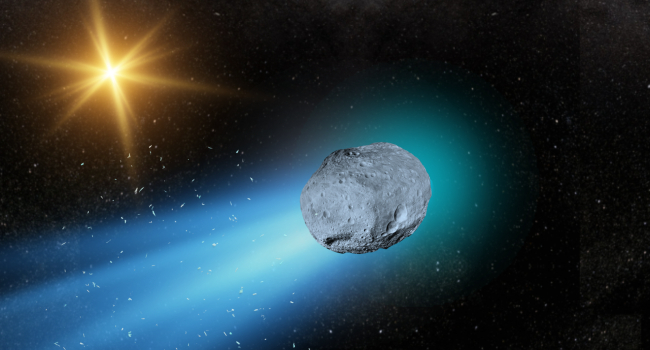
On July 1, 2025, the ATLAS telescope in Chile detected a unique object, which turned out to be the third confirmed interstellar visitor to the Solar System — comet 3I/ATLAS. According to the Royal Astronomical Society (RAS), this object may be the oldest ever observed, with an estimated age exceeding 7 billion years. This makes it older than the Solar System itself, which formed around 4.6 billion years ago. The discovery, presented at the National Astronomy Meeting (NAM 2025) in Durham, sparked major excitement among scientists, who believe 3I/ATLAS could unlock secrets about the early history of the Milky Way.
Origin: From the Milky Way’s Thick Disk
Unlike previous interstellar objects — 1I/ʻOumuamua (2017) and 2I/Borisov (2019) — comet 3I/ATLAS likely originated from the thick disk of the Milky Way. This region, situated above and below the galactic plane, is populated by stars older than 10 billion years. The comet’s trajectory, calculated using the Ōtautahi-Oxford model developed by Matthew Hopkins of Oxford University, supports its origin in this ancient stellar zone.
“There’s about a 66% chance that 3I/ATLAS is older than the Solar System,” said Hopkins, underscoring the comet’s uniqueness.
3I/ATLAS is traveling on a hyperbolic orbit with a record-setting eccentricity of 6.15, significantly higher than that of ʻOumuamua (1.2) or Borisov (3.0). It moves at a velocity of 60 km/s (216,000 km/h), confirming that it’s not gravitationally bound to the Sun and will exit the Solar System after its close approach.
Characteristics: Icy Giant with a Bright Tail
Also known as C/2025 N1 (ATLAS), comet 3I/ATLAS has a nucleus estimated to be between 0.8 and 24 km in diameter, with scientists leaning toward the smaller estimate due to its active dust coma. Rich in water ice, the comet is already showing signs of activity — at a distance of 4.5 AU (around 670 million km) from the Sun, a gas-and-dust coma and a short tail approximately 3 arcseconds long have formed.
Observations from the Very Large Telescope (VLT) and the Nordic Optical Telescope confirmed its activity. Its bluish surface and reddish coma set it apart from typical Solar System comets.
In October 2025, the comet will reach perihelion (closest approach to the Sun) at 1.36 AU, and on December 19, it will pass within 1.8 AU (270 million km) of Earth. During this period, it may reach 11th magnitude, making it visible to amateur astronomers using mid-sized telescopes by late 2025 or early 2026.
Scientific Significance: A Window into the Early Universe
3I/ATLAS is not just a rare celestial visitor, but a cosmic artifact, potentially offering clues about star and planet formation in the ancient Milky Way. Its ice-rich composition suggests it formed in cold, distant regions around a star that existed long before the Sun.
Scientists, including Professor Chris Lintott, plan to use the Hubble and James Webb space telescopes to analyze its chemical makeup, size, and rotation. These findings could validate formation models of interstellar objects developed by Hopkins.
The discovery coincides with the upcoming launch of the Vera Rubin Observatory in Chile, set to begin operations in 2025. Its 3.2-gigapixel LSST camera could detect 6 to 51 similar objects over the next decade, marking the dawn of a new era in the study of interstellar visitors.
Comparison with Its Predecessors
3I/ATLAS is the third confirmed interstellar object, following:
- 1I/ʻOumuamua (2017): A cigar-shaped asteroid without a visible coma, likely spent up to 1.3 million years in interstellar space.
- 2I/Borisov (2019): A comet discovered by amateur astronomer Gennady Borisov, with a composition similar to Oort Cloud comets.
Unlike ʻOumuamua, which showed no cometary activity, and Borisov, which resembled Solar System comets, 3I/ATLAS stands out for its ancient origin and unique trajectory from the thick disk.
Viewing Prospects
The comet has already caught the attention of observatories worldwide. In July 2025, the VLT and other telescopes captured video footage of its movement, coma, and tail. However, by late October 2025, 3I/ATLAS will temporarily disappear from view as it moves behind the Sun. Observations will resume in December, when it gets closer to Earth — offering amateur astronomers the opportunity to observe it using moderate-aperture telescopes.
Conclusion
Comet 3I/ATLAS is a truly exceptional interstellar object, potentially 7.6 to 14 billion years old, making it the oldest known comet to date. Its discovery on July 1, 2025, confirms that such deep-space visitors may be more common than previously believed. The comet’s approach to the Sun and Earth in late 2025 will provide scientists with a rare chance to study the composition and behavior of a body formed long before our Solar System.
With the Vera Rubin Observatory soon to go online, astronomers expect to find more of these ancient wanderers, expanding our understanding of the Milky Way and its oldest cosmic inhabitants.