make preferable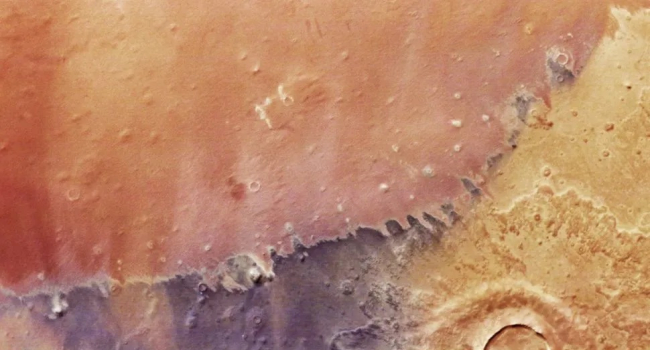
Mars, famously known as the Red Planet, appears in surprising shades of yellow, orange, brown, and even purple in a new image captured by the Mars Express orbiter of the European Space Agency (ESA). The photograph, reminiscent of a Mark Rothko painting, shows the Arcadia Planitia region — a plain full of scientific mysteries and strong potential for future missions. The image reveals a crater, dust devil trails, and striking color variations. Here’s why Mars looks so unusual and what its colors may be hiding.
What Does the Image Show?
Captured by Mars Express's high-resolution camera, the image covers part of Arcadia Planitia, located northwest of the Solar System’s largest volcanoes, such as Olympus Mons. This area interests scientists for several reasons:
- Solidified lava flows: These flows are estimated to be no more than 3 billion years old, making them relatively young in Martian terms.
- Subsurface ice: There is strong evidence that large amounts of water ice lie beneath the surface, making this region a prime target for future missions, including potential human bases.
- Impact crater: A 15 km-wide impact crater appears in the lower right. The layered material around it suggests the presence of ice during impact, and the minimal erosion indicates it may have formed relatively recently.
- Dust devils: Four mini-tornado-like dust devils can be seen in the image's center as pale, cloudy streaks. These form when sun-warmed air rises, carrying dust into the atmosphere.
Why Is Mars So Colorful?
Although Mars is traditionally called the Red Planet due to its rust-colored surface (iron oxides), this new image reveals a vibrant palette of yellows, oranges, browns, and purples. These colors are the result of surface composition and atmospheric processes:
- Reddish area: The top of the image shows a deep red hue caused by yardangs — wind-carved ridges formed when softer materials are eroded away. Iron oxides enhance the red coloration.
- Purple-brown region: Below the red zone is a part rich in silicates and poor in iron, which gives it a purple-brown tint. Differences in grain size and density also affect how sand is deposited and shifted by wind, altering its color.
- Yellow and orange tones: These areas reflect variations in soil composition and levels of oxidation. Silica-rich sands often appear lighter, resulting in yellowish and orange patches.
Why Does the Image Look Blurry?
If the image appears slightly blurred, it’s not a camera fault. This effect is caused by Martian winds. Gusts lift fine dust particles into the air, creating a thin haze that scatters light and softens features. The same wind action also sculpts yardangs and spawns dust devils, which are clearly visible in the image. Despite its thinness (only 1% the density of Earth’s atmosphere), Mars’s atmosphere can still carry dust that impacts visibility and changes the visual appearance of the landscape.
Why Is Arcadia Planitia Important?
Arcadia Planitia is a key region for Mars exploration due to its:
- Subsurface ice: Ice close to the surface makes this area ideal for water extraction, crucial for supporting human life during future missions.
- Geological history: Lava flows and craters reveal insights into Martian volcanic and tectonic activity.
- Weather phenomena: Dust devils offer valuable data for understanding atmospheric dynamics on Mars.
Images like this help space agencies plan rover landings, identify potential base sites, and study the climatic and environmental processes of Mars.
What’s Next?
ESA continues to analyze data from Mars Express to uncover new details about Mars's surface and history. Future missions — such as ExoMars or NASA’s upcoming projects — may explore Arcadia Planitia on-site. Scientists also hope to use images like this to improve Martian weather models and search for further signs of water.