make preferable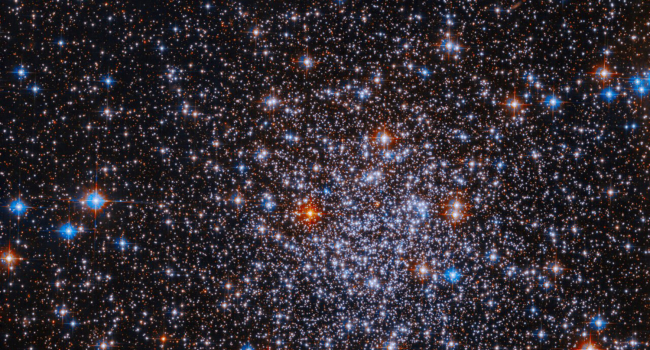
For the first time, the Hubble Space Telescope has captured a detailed image of the globular star cluster ESO 591-12, also known as Palomar 8 — a dense grouping of tens of thousands of stars bound together by gravity. The vibrant image, released by NASA, reveals stars in a range of colors: blue stars are hot and young, while red ones are cooler and older. This discovery is part of a broader project to study previously unexplored star clusters in the Milky Way. Here's why the image of Palomar 8 matters and what it reveals about our galaxy.
What Is Palomar 8?
Palomar 8 is a globular star cluster located within the Milky Way. These clusters are densely packed collections of stars, gravitationally bound, that formed during the early stages of galaxy formation from collapsing clouds of gas and dust. The stars within a cluster are born nearly simultaneously from the same cloud, which means they share similar ages and chemical compositions. This makes globular clusters invaluable “time capsules” that help scientists study the ancient history of galaxies.
Hubble’s image of Palomar 8 reveals a stunning variety of stars:
- Blue stars: hot, with surface temperatures between 30,000–50,000°C.
- Red stars: cooler, with temperatures around 3,000–5,000°C.
- Density: tens of thousands of stars packed into a spherical area roughly 100 light-years across.
How the Image Was Captured
The data on Palomar 8 was collected as part of the Hubble Missing Globular Clusters Survey, a project aimed at studying 34 previously unexamined globular clusters within the Milky Way. Many of these clusters — located in the central and outer regions of the galaxy — remained unobserved due to their distance or because dense dust clouds blocked earlier attempts to view them.
Thanks to its exceptional sensitivity and ability to observe in ultraviolet, visible, and infrared light, Hubble was able to capture Palomar 8 in fine detail. This allows scientists to analyze:
- Cluster age: determining the age of the stars helps understand when the Milky Way was formed.
- Distance: precise measurements of distance help place the cluster accurately within the galaxy.
- Chemical composition: studying the light from stars reveals what elements (e.g., hydrogen, helium, metals) were present in the early galaxy.
Why This Matters
Globular clusters like Palomar 8 are the “living fossils” of the Milky Way. Studying them allows astronomers to:
- Reconstruct the galaxy’s history: the stars carry information about cosmic processes from billions of years ago.
- Understand stellar evolution: since the stars are of the same age, scientists can compare their properties to test theories of how stars age and change.
- Map the Milky Way’s structure: data on the location and motion of these clusters helps refine our understanding of the galaxy’s layout.
What’s Next?
The Hubble Missing Globular Clusters Survey will continue studying other lesser-known clusters to build a comprehensive map of their distribution and properties across the Milky Way. In the near future, the James Webb Space Telescope will join the effort. Its infrared capabilities will allow it to see through dust clouds and complement Hubble’s data with even deeper observations.
Scientists also plan to use the findings from Palomar 8 to refine models of galaxy formation and test theories about how globular clusters influence the evolution of stellar systems. This discovery is just one piece of the ongoing effort to unlock the mysteries of our galaxy.