make preferable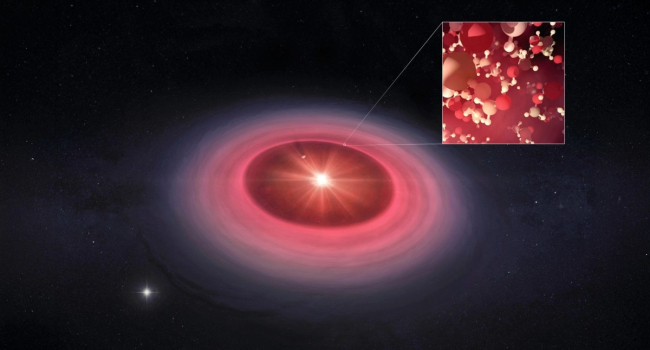
An international team of astronomers from the United States, the Netherlands, Japan, and other countries has made a significant discovery by detecting methanol and its isotopes in the gas-dust disk of a young star, HD 100453, located 330 light-years from Earth. This finding sheds new light on the origins of complex organic molecules essential for the emergence of life. The study was published in The Astrophysical Journal Letters.
First Detection of Methanol Isotopes
Methanol (CH₃OH) is considered one of the key “building blocks” for amino acids and other organic compounds that form the basis of life. While methanol has been detected before in protoplanetary disks, its isotopic variants — such as CH₂DOH and ¹³CH₃OH — have been observed for the first time. This discovery offers deeper insight into the chemical processes that occur during the early stages of planetary system formation.
The observations were made using the Atacama Large Millimeter/submillimeter Array (ALMA) in Chile. Thanks to ALMA’s high sensitivity, scientists were able to examine the chemical composition of the gas-dust disk surrounding HD 100453, a star 1.6 times more massive than the Sun. Due to the star’s greater mass, methanol remains in its gaseous form over a larger area of the disk compared to the early Solar System, making it easier to detect.
Connection to Comets and the Origins of Life
Astronomers found that the ratio of methanol to other organic molecules in HD 100453’s disk is strikingly similar to the chemical composition of comets in our Solar System, such as comet 67P/Churyumov-Gerasimenko. This supports the hypothesis that comets may have acted as “cosmic couriers,” delivering complex organic materials to Earth that were crucial for the origin of life.
“Our data suggest that icy particles in protoplanetary disks eventually come together to form organic-rich comets. Such comets likely played a key role in the emergence of life on Earth,” explained Milou Temmink, co-author of the study from Leiden University.
Significance of the Discovery
The detection of methanol and its isotopes in the HD 100453 disk carries several important implications:
- Understanding chemical evolution: Methanol isotopes help trace where and how organic molecules form in protoplanetary disks and how they migrate to future planets.
- Connection to the Solar System: The similarity in chemical makeup with comets suggests that the formation of organic matter follows universal processes across star systems.
- Search for life in space: This discovery increases the likelihood that such molecules are present in other planetary systems, boosting the chances of finding conditions suitable for life beyond Earth.
Future Research
Scientists plan to continue their observations using ALMA and other telescopes to study additional protoplanetary disks and determine how common methanol and its isotopes are in space. Upcoming missions, such as the launch of the SPHEREx telescope in 2025, are expected to provide further data on the chemical composition of stellar systems.
Moreover, the analysis of isotopes could refine models of comet formation and their role in delivering organic materials to planets — an especially important step in understanding the early history of Earth and the conditions that made life possible.