make preferable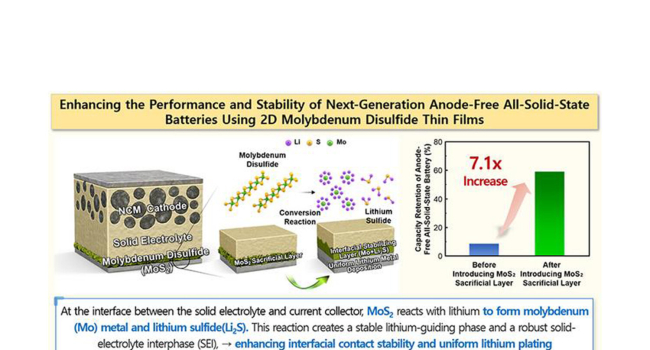
A team of scientists from South Korea has developed an innovative technology that significantly increases the lifespan of solid-state batteries — a promising alternative to conventional lithium-ion batteries. By using a low-cost material called molybdenum disulfide (MoS₂), the researchers were able to make the batteries more durable and safer. The findings were published in the journal Nano-Micro Letters (NML).
What Makes Solid-State Batteries Different?
Unlike traditional batteries that use liquid electrolytes, solid-state batteries use solid electrolytes. This enhances their safety by reducing the risk of fire and improves overall reliability. Additionally, this new technology eliminates the need for a traditional anode: lithium is deposited directly onto the current collector during the first charge, which increases the battery’s capacity.
However, until now, these batteries had a major drawback — they wore out quickly due to the formation of lithium dendrites (spiky deposits), which damaged the internal structure of the battery.
The Role of Molybdenum Disulfide (MoS₂)
The breakthrough came with the application of a thin layer of molybdenum disulfide (MoS₂) to key components of the battery. This material prevents the growth of lithium dendrites, thereby protecting the battery from premature failure. In testing, batteries with the MoS₂ coating demonstrated exceptional durability, lasting over 300 hours, compared to standard batteries, which degraded much more quickly.
Advantages and Outlook
The use of MoS₂ not only extends the battery lifespan by seven times, but also maintains high energy capacity. This advancement is considered a major breakthrough for electric vehicles, smartphones, and other technologies that demand long-lasting and reliable power sources. Thanks to its low cost and widespread availability, MoS₂ could also make manufacturing these batteries economically viable.
The Future of Solid-State Batteries
Researchers are confident their development could revolutionize the battery industry. They predict that solid-state batteries with molybdenum disulfide coatings could enter the commercial market as early as 2032, gradually replacing conventional lithium-ion batteries.
This technology marks a step forward in making safer, longer-lasting, and more efficient energy storage systems for the next generation of electronics and electric transport.