make preferable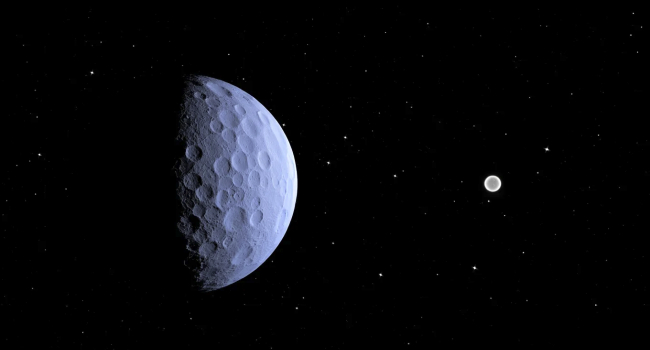
American astronomers have announced a sensational discovery on the distant outskirts of the Solar System — a trans-Neptunian object (TNO) designated 2017 OF201. Identified through analysis of archival telescope data, the object may qualify as a dwarf planet, making it one of the most significant discoveries in this field over the past decade. A preprint of the study, published on arXiv, has sparked wide interest.
Characteristics of 2017 OF201
2017 OF201 has the following features:
- Size: Its diameter is estimated at 700 km (assuming an albedo of 0.15), making it the second-largest object in its dynamic population after Pluto (2377 km). This size is sufficient for it to be classified as a dwarf planet, similar to Ceres, Eris, or Makemake.
- Orbit: The orbit is highly eccentric, with a semi-major axis of 838 AU and a perihelion of 44.9 AU (comparable to Pluto). The aphelion stretches to 1600 AU, placing it near the inner Oort cloud. One full orbit around the Sun takes about 25,000 years.
- Current Position: It is currently 90.5 AU from the Sun, making it one of the ten most distant optically observed objects in the Solar System.
- Brightness: With an absolute magnitude of H = 3.5, the object reflects a significant amount of light and is likely spherical.
2017 OF201 was identified in 19 archival images taken between 2011 and 2018 by the Victor M. Blanco telescope (DECam) and the Canada-France-Hawaii Telescope (CFHT). A team led by Sihao Chen (Institute for Advanced Study, Princeton) used a computational algorithm to detect moving objects in the data.
Orbital Mystery and the Challenge to the Ninth Planet Hypothesis
The orbit of 2017 OF201 is highly unusual. Most extreme trans-Neptunian objects (ETNOs) exhibit orbital clustering, often interpreted as the gravitational influence of a hypothetical Ninth Planet — a massive body thought to be 5–10 times the mass of Earth. However, 2017 OF201 does not fit this pattern; its longitude of perihelion lies outside the observed cluster.
Modeling shows that if the Ninth Planet existed, 2017 OF201 would likely have been ejected from the Solar System within a few hundred million years due to interactions with Neptune. In contrast, without the Ninth Planet, its orbit remains stable for over 1 billion years under the influence of Neptune and galactic tides. This reduces the likelihood of the Ninth Planet’s existence, although Sihao Chen emphasizes that more data is needed before drawing firm conclusions.
Konstantin Batygin, co-author of the Ninth Planet hypothesis, disputes these findings, arguing that 2017 OF201 is strongly influenced by Neptune and its orbit is unstable, which does not contradict the hypothesis. Chen, however, considers the object to lie on the edge of orbital stability.
Origin and Significance of the Discovery
The eccentric orbit of 2017 OF201 hints at a complex history. Scientists believe it may have been flung to the outer Solar System through gravitational interactions with a giant planet, such as Neptune or Jupiter. A two-step process is also possible: first ejection into the Oort cloud, followed by a return to the inner system.
The discovery challenges the idea that the region beyond the Kuiper Belt (50–70 AU) is nearly empty. The object is visible for only 0.5–1% of its orbit, implying that hundreds of similar objects may exist, too distant to detect. Their combined mass could be up to 1% of Earth’s mass, comparable to the scattered disk.
Future Research
Chen’s team has submitted proposals for follow-up observations of 2017 OF201 using the James Webb Space Telescope, Hubble, and the ALMA radio telescope. These instruments will help determine the object’s size, albedo, surface composition, and the potential presence of moons. High-resolution, time-sensitive imaging may also reveal its rotation and shape.
The object’s color, according to data, is on the reddish end of the TNO spectrum, typical of scattered disk objects. The lack of brightness variation greater than 0.1 magnitudes supports the idea of a spherical shape, consistent with dwarf planets.
Scientific Implications
The discovery of 2017 OF201 reshapes our understanding of the Solar System’s outer boundaries. It highlights the potential for a significant population of large objects beyond the Kuiper Belt, warranting revisions to models of Solar System formation. If the Ninth Planet’s existence is ultimately refuted, it would mark a turning point in the study of TNO dynamics.
The use of publicly available archival data for this discovery demonstrates the power of open science and citizen participation in astronomy. As co-author Jiaxian Li noted, any researcher — or even an amateur with the right tools — could have made this discovery.