make preferable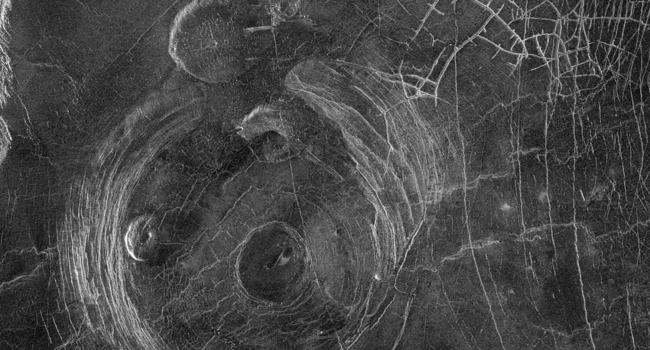
An international team of scientists has uncovered new evidence of active geological processes on Venus by studying giant ring-shaped structures known as coronae. These formations, spanning hundreds of kilometers in diameter, point to ongoing tectonic activity on the planet. The study, published in Science Advances, is based on data collected by the Magellan mission in the 1990s.
What Are Coronae and How Do They Form?
Coronae are unique geological structures formed when hot mantle plumes—streams of molten rock—rise toward Venus’ surface, deforming its lithosphere. Of the 75 coronae studied, 52 showed signs of active processes, indicating ongoing subsurface activity. Scientists used three-dimensional modeling and gravitational anomaly analysis to confirm that molten material movements are still occurring beneath many coronae.
Mechanisms of Corona Formation
The researchers identified three possible processes that may create coronae:
- Subduction: A process similar to Earth’s, where one part of the lithosphere sinks beneath another.
- Capping: The sinking of heavier crustal fragments into the mantle.
- Volcanic Activity: Eruptions triggered by mantle plumes, forming ring-shaped structures.
These mechanisms suggest that Venus remains a geologically active planet, despite lacking the plate tectonics characteristic of Earth.
Connection to Earth’s History
Coronae on Venus offer a unique opportunity to glimpse the geological past of our planet. Scientists propose that similar structures may have existed on early Earth billions of years ago, before the development of modern plate tectonics. “Studying Venus helps us understand what Earth might have looked like in its early evolutionary stages,” said Gaël Cascioli, the study’s lead author from NASA’s Goddard Space Flight Center.
Significance of the Discovery
The new research reveals that Venus is not a static world but a planet with active and diverse geological processes. Coronae, previously thought to be remnants of ancient activity, are now linked to current mantle movements. This finding challenges the view of Venus as a “frozen” planet and highlights its dynamic nature.
Prospects for Science
Data from the Magellan mission, combined with advanced analysis techniques like 3D modeling, are opening new horizons for studying Venus. Scientists hope that future missions, such as DAVINCI or VERITAS, will provide more detailed data on the crust’s composition and mantle activity. This will refine models of corona formation and their connection to the planet’s internal processes.