make preferable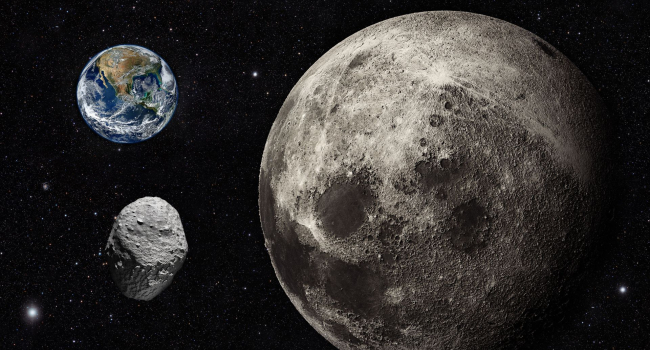
Asteroid 2024 PT5 has left Earth and is no longer considered a conventional second Moon. The object, about 11 meters in diameter, approached Earth on September 29, 2024 under the influence of our planet’s gravity and spent less than two months “in company” with it.
During this time, astronomers had more opportunities to get acquainted with 2024 PT5 and came to the conclusion that it could be a fragment of the Moon.
Object 2024 PT5 is part of the Arjuna group of asteroids. They move around the Sun in a close orbit to the Earth and are generally considered near-Earth objects. Observations of 2024 PT5 have revealed that it rotates quite quickly, in less than an hour, which is what happens when an asteroid strikes.
This discovery gave rise to the assumption that the Arjuna asteroids were formed as a result of large celestial bodies hitting the Moon. There are many large craters on the surface of the satellite, so this possibility should not be surprising.
According to scientists, in order for 2024 PT5 to be considered a “small moon”, it would have to approach Earth at a distance of 4.5 million km, having a constant speed of about 3540 km / h. In late September 2024, the asteroid 2024 PT5 fully met these conditions. It became a temporary small moon of our planet, which remained next to the planet for about 56.6 days. NASA, interestingly, is not inclined to consider 2024 PT5 even a temporary satellite of the Earth.
The agency believes that it has never been under the influence of Earth's gravity and has left as soon as it arrived. However, NASA will continue to monitor this object with the forces and means of planetary defense. Asteroid 2024 PT5 will approach Earth again on January 9, 2025. The agency promises to keep the object “on target” with the 70-meter antenna of the Goldstone Solar System Radar in California. After that, the “small Moon” will leave near-Earth space for 30 years.