make preferable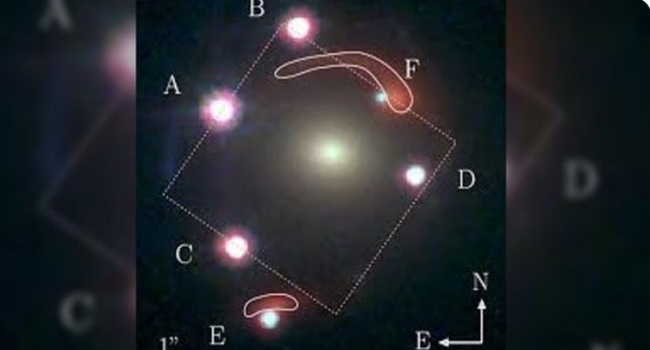
The James Webb Space Telescope (JWST) has confirmed the existence of a previously hypothetical phenomenon known as the "Einstein zigzag." This effect was discovered in the J1721+8842 system, where light from a single quasar passes through two distinct regions of warped spacetime, creating six identical copies of the object.
Initially, scientists believed J1721+8842 to be a double quasar, with each quasar gravitationally lensed three times. However, new data from JWST revealed that all six points of light originate from a single quasar. The two faintest duplicate images are bent around opposite sides of each lensing object, forming a unique configuration now called the Einstein zigzag.
Gravitationally lensed objects like "Einstein rings" and the "Einstein zigzag" are vital in astronomy and cosmology. They allow scientists to measure the mass of lensing galaxies and investigate phenomena such as dark matter and dark energy. The advanced capabilities of JWST have significantly enhanced the detection of such objects in distant regions of the universe.
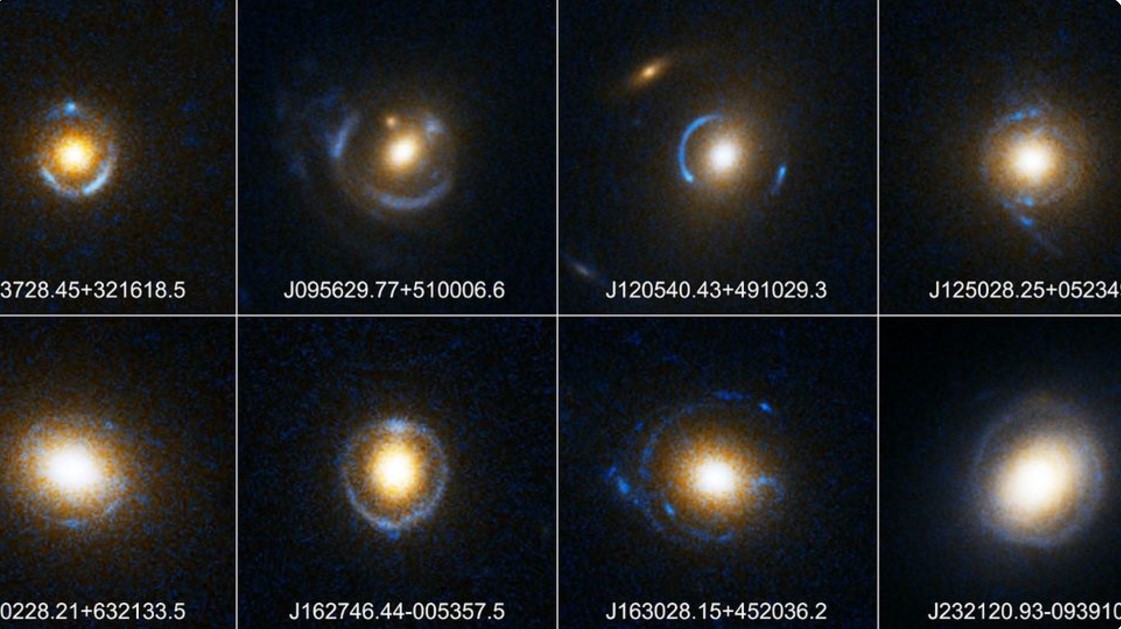
Despite JWST's breakthroughs, it has also highlighted discrepancies in our understanding of cosmology, including the so-called "Hubble tension" — a problem arising from differences in the measured expansion rates of various regions of the universe. Researchers believe that studying the Einstein zigzag could help address this issue. Its unique configuration enables astronomers to accurately measure the Hubble constant and assess the amount of dark energy in this area of space.
Thomas Collett, an astrophysicist at the University of Portsmouth who was not involved in the study, commented: "Studying the zigzag will shed light on whether the universe's expansion rate aligns with our cosmological model." However, he added that researchers might need over a year to extract the necessary data from the complex images, meaning results will take time.
The study was uploaded to the arXiv preprint server on November 8 and submitted for review to the journal Astronomy & Astrophysics. While it has not yet undergone peer review, the research has already generated significant interest within the scientific community and could contribute to resolving one of the most pressing challenges in modern cosmology.