make preferable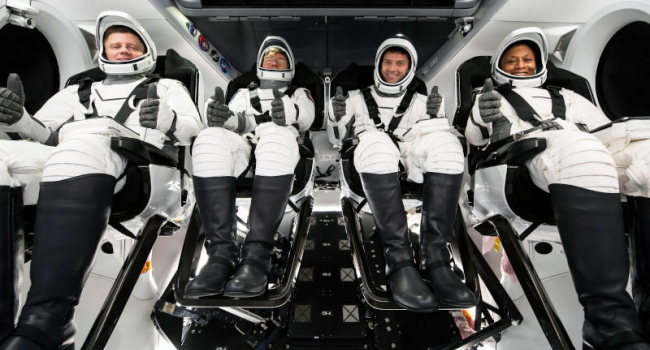
American astronauts who returned from the International Space Station (ISS) in October encountered several challenges during their mission, and some of these difficulties continued to affect them on Earth. However, both the astronauts and NASA are refusing to disclose details about the incidents, this is reported by Arstechnica.com.
During the mission, NASA had to interrupt two spacewalks under mysterious circumstances. Later, on October 25, one astronaut was hospitalized due to a “medical issue” after the SpaceX Crew Dragon capsule landed, concluding a 235-day mission. After spending the night in the hospital, the astronaut was released in “good health,” returned to their base in Houston, and resumed regular post-flight activities. The space agency did not disclose the astronaut’s name or specific health details, citing medical confidentiality.
In October, the Crew Dragon capsule brought back commander Matthew Dominick, pilot Michael Barratt, mission specialist Jeanette Epps, and Russian cosmonaut Alexander Grebyonkin—who was not hospitalized. At a press conference on Friday, Dominick, Barratt, and Epps declined to reveal the name of the hospitalized astronaut or details of the medical issue. Initially, NASA sent all four crew members to a hospital in Pensacola, Florida, for examination, but the Russian and two Americans were quickly discharged and returned to Houston. One astronaut remained in the hospital for an additional day.

“We still don’t fully understand spaceflight. Sometimes we encounter the unexpected. This was one of those cases, and we’re still gathering information on this matter. To ensure medical confidentiality and allow our processes to advance appropriately, that’s all we can say at this time,” commented Michael Barratt, who is also a physician and flight surgeon.
NASA usually provides health data on astronauts to external researchers who publish regular studies, and one of the main goals of ISS missions is to study the human body’s reaction to spaceflight. However, the agency must also adhere to U.S. federal regulations, including the Health Insurance Portability and Accountability Act (HIPAA) of 1996, which limits the disclosure of private medical information.
The mystery extends beyond the medical issue related to the Crew-8 mission. On June 13, Dominick and American astronaut Tracy Dyson were scheduled for a spacewalk, but NASA canceled the operation due to a “suit discomfort issue.” Dominick was replaced by Barratt, and the spacewalk was rescheduled for June 24, when the mission was to retrieve a faulty electronic unit and collect microorganism samples. However, it was cut short after 31 minutes when Dyson reported a water leak in the suit’s service and cooling line. Barratt discussed the leak in detail during the press conference, while Dominick declined to answer questions about the discomfort issue.
The water leak incident was broadcast live on NASA TV: ice particles were visible in the airlock with the open hatch, settling on Dyson’s helmet and gloves. Once the leak stabilized, the astronauts closed the hatch and began repressurizing the airlock. The issue was determined to stem from equipment deficiencies rather than astronaut actions. By then, NASA faced other priorities: scientific experiments, the arrival of a cargo spacecraft, and testing of the Boeing Starliner capsule. The spacewalk mission wasn’t urgent, and NASA plans to attempt it again in January with a different crew.
Barratt stated that the ISS suits are ready for the next spacewalk attempt but acknowledged their age: the original design is over 40 years old, and there are no new models yet. In June, Collins Aerospace ended its contract with NASA to develop new suits for ISS maintenance and future orbital stations, so Barratt didn’t rule out further issues with the aging suits.