make preferable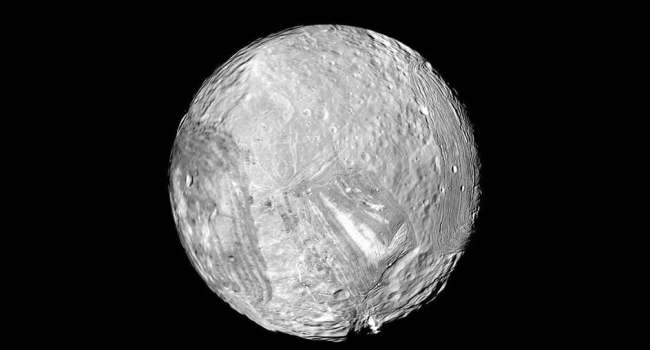
A group of American scientists has mapped the surface of Miranda, a moon of Uranus, modeled the mechanisms of tidal pressure on it, and concluded that an ocean of liquid water may exist beneath its surface.
According to scientists’ estimates, the ocean on Miranda is at least 100 km thick and has existed for the past 100–500 million years. However, it is not on the moon's surface but lies about 30 km deep.
To support their hypothesis, scientists point out that if the water on Miranda had completely frozen, specific types of cracks would have appeared on the moon's surface, indicating the expansion of the frozen ocean from within. However, analysis of existing images of the moon revealed that such cracks are absent.
One of the images of Miranda was obtained by the American spacecraft Voyager 2, which passed by it in 1986. The image showed a rugged surface covered in grooves and craters, which scientists believe were formed due to tidal forces and the moon’s internal heating.
Based on surface features, scientists modeled the internal structure of Miranda by analyzing stress and shear mechanisms to infer the internal forces that could have shaped its appearance. They believe that the deep ocean could have formed as a result of a thermal impulse caused by an orbital shift due to Miranda's gravitational interaction with other moons of Uranus.
“A deep ocean like this could have made Miranda very similar to [Saturn’s moon] Enceladus and potentially habitable in the geologically recent past,” the researchers believe.