make preferable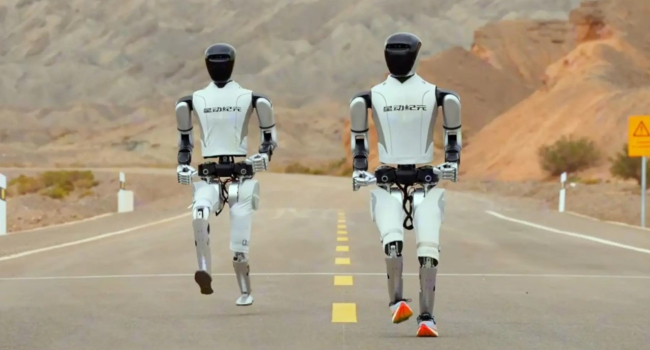
Robot Era, a rising name in the humanoid robot space, has released dramatic footage of its flagship humanoids, Star1, racing through the Gobi Desert. The video showcases two Star1 models sprinting across rocky and grassy terrains, navigating winding desert roads. One robot ran “bare-footed,” while the other donned sneakers, highlighting the machines' adaptability to various surfaces.
Robot Era, incubated from Tsinghua University in 2023, has quickly made a name for itself with advanced humanoid designs and attention-grabbing promo videos. The 1.71-meter tall, 65-kilogram Star1 robots can run at speeds of up to 3.6 meters per second (8 mph). In the desert race, the sneaker-clad robot, though starting late, overtook its opponent to finish first after 34 minutes.
The company emphasizes the importance of controlling a robot's limbs and center of gravity for autonomous movement on uneven terrain. According to Robot Era, the Star1 models can switch between walking, running, and jumping modes using adaptive joints and AI-powered control systems. Their proprietary 400-Nm joint motors, precision sensors, and AI computing of up to 275 tops allow them to navigate diverse environments effectively.
Robot Era also announced that Star1 integrates large language models and advanced machine learning, enabling it to learn new skills and adapt to complex tasks. The company highlighted its development of a "denoising world model," which minimizes environmental interference during real-world operations.
The Star1 is just one of many humanoid robots competing in the rapidly growing market, alongside models from Tesla, Figure, and Unitree. Robot Era aims to bring its AI-powered humanoids into homes and workplaces, positioning itself as a key player in the evolving robotics industry.