make preferable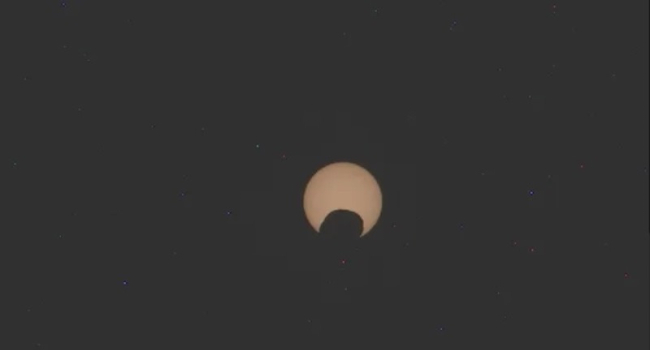
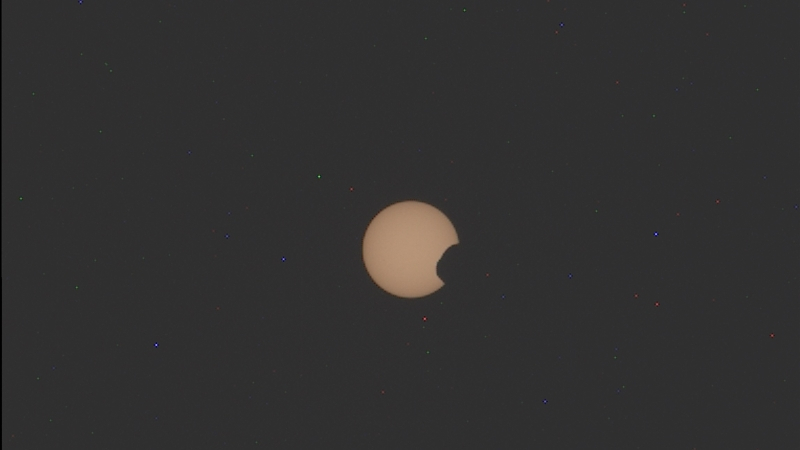
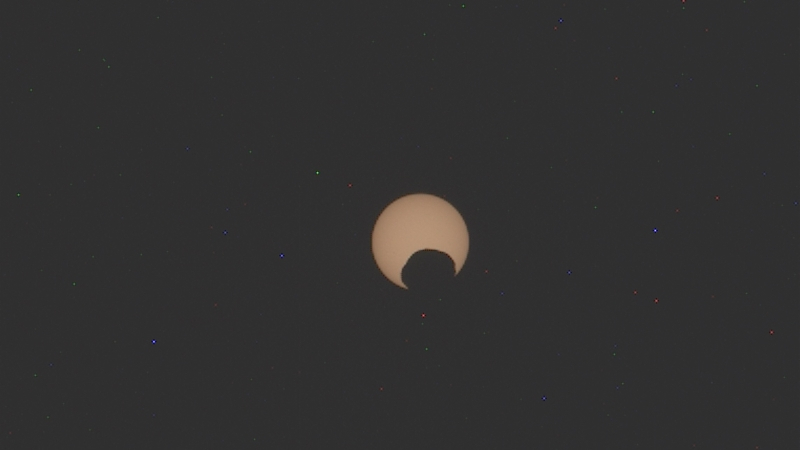
NASA's Perseverance rover captured a solar eclipse with its Mastcam-Z camera late last month, when one of Mars' two moons, Phobos, partially covered the Sun. In a series of photos taken on September 30, you can clearly see the outlines of the small moon of Mars.
Phobos measures about 27 × 22 × 18 km. It orbits exceptionally close to the planet, only 6,000 km away. For comparison, let's note that the moon of our planet, the Moon, is located at a distance of 384,000 km from the Earth. Phobos rotates at a high speed, it is able to make three rotations around Mars per day.
Although Phobos looks like an asteroid, some scientists don't consider it a Martian asteroid for one main reason: its orbit around the planet is almost perfect. If Phobos were indeed an asteroid that flew past Mars and fell into its gravitational field, it probably wouldn't have such an ideal orbit.
Modern theories about the origin of Phobos and Deimos, the second moon of Mars, are based on the assumption that they formed from material left over from the formation of the planet itself. Other scientists do not rule out that the Martian satellites were formed as a result of a collision between the planet and another space object.
As for the fresh photos taken by Perseverance, this is not the first time that the rover has managed to capture a solar eclipse. The rover first captured a solar eclipse from the Martian surface in April 2022 and again in February 2024. Interestingly, Perseverance wasn't even the first rover to take pictures of a solar eclipse. The twin rovers Spirit and Opportunity observed the passage of Phobos behind the Sun back in 2004, and the Curiosity rover even captured video of the eclipse in 2019.