make preferable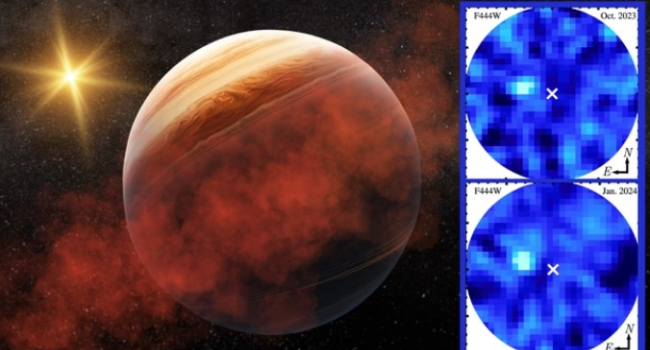
The James Webb Space Telescope (JWST) has photographed the lowest-mass exoplanet outside the Solar System. AF Leporis b (AF Lep b) is located 88 light-years from Earth and is a young planet, only 23 million years old. Its mass is 3.2 times that of Jupiter, and it is about 1.2 times that of the Solar System's gas giant.
In 2023, AF Lep b became the lowest-mass extrasolar planet discovered by direct observation. It then became the lowest-mass exoplanet whose mass has been measured using "astrometry," a technique that tracks a star's motion to detect "fluctuations" caused by the gravity of an orbiting planet.
Kyle Franson, a scientist at the University of Texas, said that AF Lep b is in the limit zone of the telescope's maximum potential. “Despite its extraordinary sensitivity, JWST is smaller than our largest telescopes on Earth. And we see at longer wavelengths, which causes objects to appear dimmer. It becomes difficult to separate one source from another when they appear so close to each other," he said.
However, because AF Lep b is 88 light-years from Earth, it appears to telescopes as a tiny dot. However, astronomers can learn many useful things from that "point".

Since the discovery of the first exoplanet in the 1990s, the exoplanet catalog has grown and now includes more than 6,000 entries, with thousands more to be confirmed. However, very few of them were photographed directly. Most exoplanets are detected by the impact they have on their host star, either when they block light by crossing the disk of their star, or by the gravitational influence they have on that star. When viewed from a distance of many light-guides, the angular distance between exoplanets and their stars becomes very small, making them difficult to distinguish.
JWST has the advantage of observing exoplanets as they orbit their stars. That tool is called a coroner. It blocks the light from the star, so the planets orbiting them are easier to observe. AF Lep b is a good candidate for such an observation because, as a very young planet, its brightness is strong.
The team of astronomers found from their observations that AF Lep b has a very active atmosphere, where convection currents mix elements between its lower and upper levels. Scientists also found more carbon monoxide around AF Lep b than expected. They suggest that strong updrafts are the only way to transport this gas into the planet's upper atmosphere.