make preferable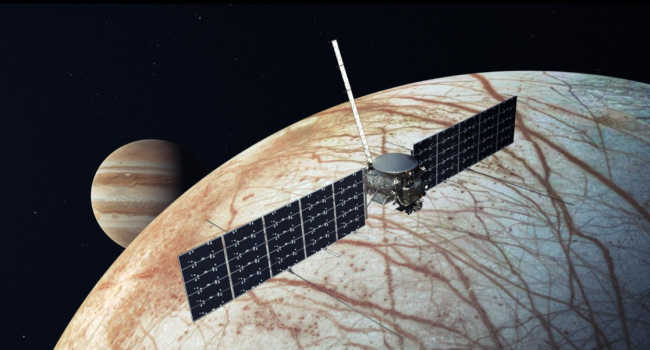
The Europa Clipper spacecraft has been launched into space to study whether Jupiter's moon Europa has conditions suitable for life, NASA's press service reported.
The probe was launched using SpaceX's heavy-lift Falcon Heavy rocket. Europa Clipper took off from Launch Complex 39A at Kennedy Space Center in Cape Canaveral, Florida, at 12:06 Eastern Time (19:06 Moscow Time). The launch was originally scheduled for October 10, but it was postponed due to the aftermath of Hurricane Milton.
The spacecraft will have to travel approximately 2.9 billion kilometers to enter orbit around Jupiter in April 2030. It will begin its scientific flights around Europa in 2031. As NASA notes, the probe is equipped with the most advanced set of scientific instruments the agency has ever sent to Jupiter, including radars, cameras, and a heat-measuring tool.
Europa Clipper's three main scientific goals are to determine the thickness of the moon's ice shell, investigate the composition and geology of the subsurface ocean.
"If the mission determines that Europa is habitable, it could mean that there are more worlds suitable for life in our Solar System and beyond than previously thought," the statement said.
Europa is the sixth-closest moon to Jupiter and has long been considered one of the most potentially habitable places in the Solar System (excluding Earth). NASA's Juno mission conducted the first detailed study of the moon in 2024. The results showed that Europa's icy surface contains less oxygen than previously thought.
This finding does not rule out the possibility of microbial life on Europa. Data from the Galileo mission revealed that there is water beneath the moon’s icy surface, roughly twice the volume of Earth's oceans.
Europa’s ocean floor is in contact with rocky material, allowing chemical interactions that produce energy. This makes Jupiter's moon a prime candidate for the existence of life.