make preferable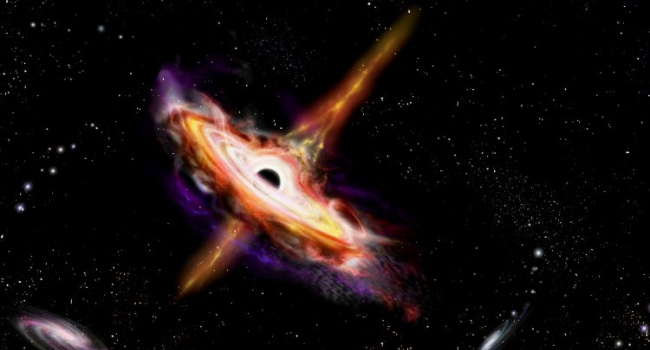
An international team of researchers has discovered the largest galactic structure known to date. This structure is made up of huge jets of matter and energy emanating from a supermassive black hole. The jets span an impressive 23 million light years (about 7 million parsecs). The discovery was published in the prestigious scientific journal Nature.
The phenomenon is called "Porphyrion" after the ancient Greek king of giants. In terms of scale, Porphyrion can be compared to the cosmic web - a vast network of intergalactic gas filaments.
As Martin Oei, an astronomer from Leiden University, noted, if Porphyrion were reduced to the size of Earth, the black hole producing these powerful jets would be only 0.2 millimeters in size - about the size of an amoeba. However, despite its modest size, this "amoeba" creates gigantic jets.
It is worth noting that Porphyrion is not the only structure of this scale. Scientists also know of the Alcyoneus galaxy, whose jets extend for 16 million light years.
However, researchers cannot yet explain how exactly such colossal jets as those of Porphyrion and Alcyoneus are formed and maintained at such gigantic distances. In order to create a jet of this scale, a black hole must constantly absorb huge volumes of matter over a billion years, which in itself is rare.
In addition, as the length of the jet increases, it should become increasingly unstable and, eventually, dissipate. However, the jets of Porphyrion and Alcyoneus remain stable, even over such huge distances. How exactly this happens remains a mystery to modern science.