make preferable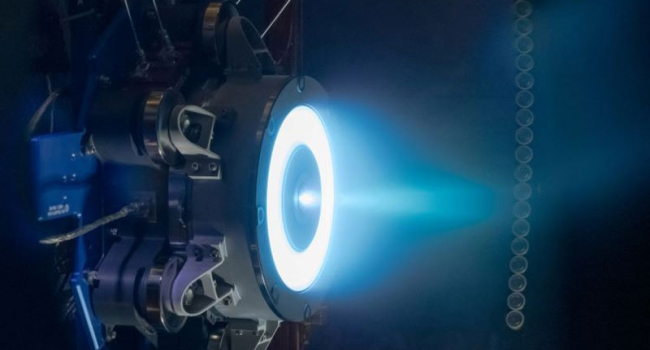
NASA has completed qualification testing of its most powerful new generation ion engine. Its power is 12 kW. For comparison, before this the most powerful electric rocket engine was a 4.5 kW unit.
Designed and manufactured by Aerojet Rocketdyne, the new electric propulsion engine, known as AEPS (Advanced Electric Propulsion System), will be a key component of the Gateway lunar orbital station, designed to maintain and correct orbit. Gateway Station will be used for missions to the lunar surface and assembling ships for flights to Mars.
The first of the engines for the Gateway station was delivered to NASA’s Glenn Research Center in Cleveland this July. AEPS has already been tested in the vibration and vacuum chamber of the center.
The second engine will be delivered for qualification testing in 2024 and is planned to operate at thrust levels equivalent to launching the Gateway station into orbit around the Moon. The fire test in the test chamber will last about 4 years or 23,000 hours, during which the engine will be tested under long-term loads.
Three such engines are planned for the Gateway station, which will be mounted on the station's power module (PPE, Power and Propulsion Element). The module is scheduled to be launched into space in November 2025 on a SpaceX Falcon Heavy rocket. The engines will be powered by the station's 60 kW solar panel system.
AEPS engines operate on the Hall effect and use xenon (one tank with 2 tons of xenon can be enough for 15 years of operation). They are distinguished by their high efficiency and the ability to operate for a long time on limited fuel reserves, although they cannot boast of high thrust.
Currently, the German company OHB is developing xenon refueling systems - Xenon Transfer System (XTS). To extend the life of the Gateway, you can expect the station to be refueled from time to time.