make preferable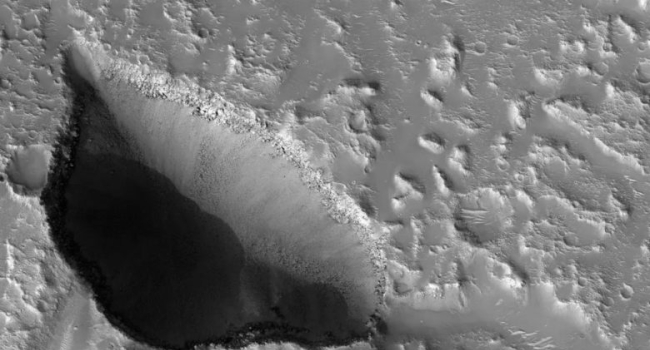
Mars is no longer just a red dot in the night sky — it has become a world with its own geological history, where every crater and collapse hints at the planet’s past. A new discovery by researchers from Shenzhen University adds an unexpected chapter to this story: scientists have identified the first karst caves on the Red Planet, formed not by volcanic activity but by ancient flowing water. Eight deep sinkholes in the region of Ghebrous Valles may turn out to be prime sites for searching for traces of Martian life and excellent natural shelters for future astronauts. The study, published in The Astrophysical Journal Letters, opens a new page in Martian exploration.
Karst on Another Planet: How Water Dissolved Mars
On Earth, karst caves are common: water seeps into cracks, dissolves limestone, gypsum, or salt, and over time forms cavities that collapse into sinkholes. On Mars, lava tubes — long channels left behind by ancient volcanic eruptions — have dominated the landscape until now. The newly identified structures in Ghebrous Valles (in the planet’s northwestern region) have a different origin.
These sinkholes appear as nearly perfect circles, ranging from tens to hundreds of meters in diameter, with no raised rims or ejected debris — unlike impact craters. Thermal emission data from the TES spectrometer aboard the Mars Global Surveyor showed that the surrounding rocks are rich in carbonates and sulfates, minerals that dissolve easily in water. Three-dimensional models built from high-resolution images captured by the Mars Reconnaissance Orbiter confirmed that the shapes of the sinkholes are best explained by the collapse of underground voids.
The authors of the study suggested that these structures may represent the first documented karst caves on Mars — entrances formed by the dissolution of highly soluble rocks by ancient water.
Why Caves Are Key to Martian Life
On Earth, karst systems are true refuges for microorganisms. They offer protection from ultraviolet radiation, extreme temperature swings, and dryness. On Mars, where the surface is sterilized by radiation and oxidizing agents, underground voids may have served as the last safe havens for hypothetical life.
- Radiation protection: caves have cosmic ray levels hundreds of times lower than the surface.
- Moisture: carbonates and sulfates are often associated with ancient aquifers; ice or even briny liquid water may persist within pore spaces.
- Organic preservation: if life existed 3–4 billion years ago, its traces could be preserved in cave wall deposits.
Shelters for Humans: A Base Underground
For future Martian missions, caves represent more than scientific curiosity — they may serve as ready-made habitats.
- Radiation shielding: 5–10 meters of regolith overhead can reduce exposure to levels comparable to Earth.
- Thermal stability: interior temperatures fluctuate far less than the surface, which swings from –140°C at night to +20°C during the day.
- Resources: ice could provide water, and minerals could be used for construction.
The Ghebrous Valles region is already among the priority targets for NASA’s Artemis program, China’s Mars Sample Return mission, and ESA’s ExoMars project. Such caves may become the first destinations for subsurface rovers or drone missions equipped with radar.
What Comes Next: From Orbit to Descent
This discovery is based on orbital observations, but confirmation will require surface missions. Researchers propose:
- Subsurface radar surveys (similar to MARSIS on Mars Express) to map underground cavities
- Drone missions to fly around and image cave entrances
- Next-generation rovers capable of descending into sinkholes, similar to the Mars Cave Explorer concept
In Brief
Eight karst caves have been discovered in the Ghebrous Valles region of Mars — the first known caves formed by ancient water rather than volcanic activity. They may be ideal refuges for past life (radiation shielding, potential moisture) and future astronauts (natural bases). These caves are priority targets for the search for extraterrestrial life and future colonization efforts. Beneath its surface, Mars may be far more hospitable than we imagined.