make preferable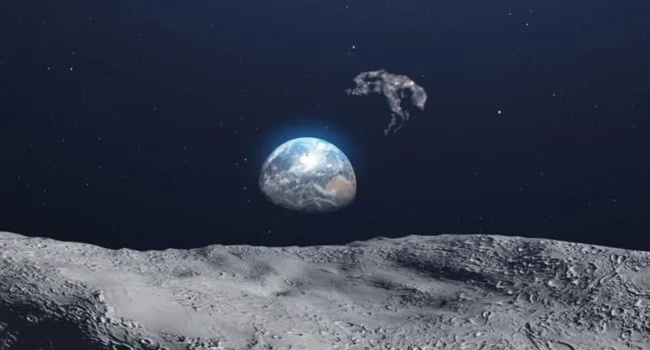
The Moon appears to be a calm and serene world — with no wind, rain, or atmosphere. In reality, however, its surface is constantly bombarded by micrometeoroids, tiny particles ranging in size from dust grains to peas and traveling at speeds of up to 70 km/s. A new study led by Daniel Yahalomi has, for the first time, provided a quantitative assessment of this threat to future lunar bases planned under NASA’s Artemis program. According to results published in an arXiv preprint, even the safest regions of the Moon will require essential protection from these cosmic “bullets”.
A Rain from Space: The Scale of the Threat
On Earth, micrometeoroids burn up in the atmosphere, turning into harmless meteors. On the Moon, they reach the surface at full force. The researchers used the Meteoroid Engineering Model, a mathematical framework that accounts for the Moon’s orbit, Earth’s gravitational influence, and meteor streams.
For a hypothetical lunar module comparable in size to the ISS (approximately 500 m² of surface area), calculations produced alarming numbers: between 15,000 and 23,000 impacts per year from particles weighing between 10⁻⁶ g and 10 g. The study noted that even a microgram-sized particle traveling at 20 km/s carries the kinetic energy of a pellet fired from an air gun, which is sufficient to puncture metal, create a crater, and damage equipment.
Where the Danger Is Greatest: A Map of Lunar “Fire”
The intensity of impacts varies across the Moon. Differences between the poles and the Earth-facing equatorial region reach a factor of 1.6. The lowest impact rates are found at the South Pole, the planned site of NASA’s first Artemis base. This is attributed to orbital geometry, as Earth partially “shields” the poles from meteor streams.
- South Pole: ~15,000 impacts per year
- Equator (Earth-facing side): up to 23,000 impacts per year
How to Protect Astronauts: Whipple Shields on the Moon
To provide protection, researchers propose adapting Whipple shields — multilayer aluminum panels already used on the ISS. Their principle is straightforward: the outer layer breaks the incoming micrometeoroid into fragments, and the inner wall captures the resulting debris cloud.
Yahalomi’s model enabled calculations of the minimum required shielding thickness depending on:
- Particle mass and velocity
- Module surface area
- Lunar region
For example, at the South Pole, an external layer of 2–3 mm of aluminum is considered sufficient. However, the study emphasized that each additional kilogram of shielding corresponds to millions of dollars in transport costs from Earth.
The Future of Lunar Bases: Living Under a “Rain”
For astronauts, micrometeoroids will become a routine challenge — just like radiation or lunar dust. Continuous monitoring, regular inspections, and repairs will be necessary. In the long term, the development of underground habitats or 3D-printed regolith-based shields is seen as a practical solution.
In Brief
The Moon experiences between 15,000 and 23,000 micrometeoroid impacts each year, and many are capable of penetrating metal. The safest region is the South Pole, where the Artemis base is planned. Protection relies on Whipple shields, whose required thickness has now been calculated with a new model. Micrometeoroids represent an invisible but constant threat to lunar missions. Without adequate shielding, a long-term presence on the Moon is impossible.