make preferable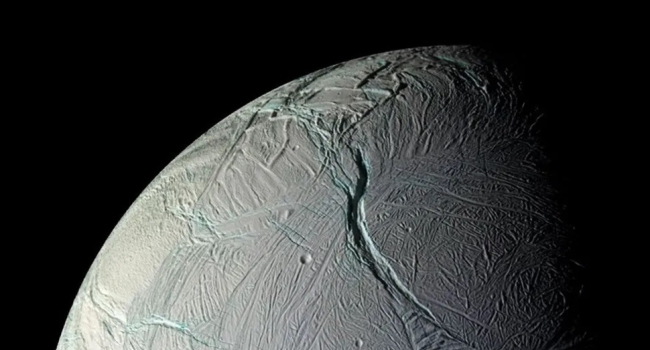
Saturn’s moon Enceladus continues to astonish scientists. A new analysis of data from NASA’s Cassini mission has revealed that the moon’s north pole emits more heat than expected — 7°C warmer than model predictions. This discovery points to a delicate internal energy balance that has kept Enceladus’s global subsurface ocean stable for billions of years. The findings, published on November 7, 2025, in Science Advances, strengthen Enceladus’s position as one of the most promising places to search for life beyond Earth.
Cassini’s Discovery: Plumes and a Hidden Ocean
Enceladus is an active ocean world, first identified as such by Cassini in 2005. Giant plumes of water vapor erupt from cracks known as the “tiger stripes” near the moon’s south pole, ejecting up to 300 kilograms of water per second into space.
The energy source is tidal heating caused by gravitational interactions with Saturn — as Enceladus is pulled and compressed, internal friction generates heat that keeps water beneath its icy crust in a liquid state.
The global ocean lies about 20–23 kilometers beneath the north pole, with an average depth of 25–28 kilometers. The plumes contain organic molecules, salts, and silica — key ingredients for life. The central question for scientists has been how such an ocean could remain liquid over geological timescales.
Excess Heat: 7°C and 46 mW/m²
A research team led by Francis Miles (University of California, Berkeley) compared data from Cassini’s CIRS instrument, observing the north pole during Saturn’s “winter” in 2005 and “summer” in 2015.
Model predictions fell short — the actual temperature was 7°C higher than expected. The heat flux measured 46 milliwatts per square meter, roughly two-thirds of Earth’s continental average. Globally, Enceladus loses about 54 gigawatts of heat — nearly identical to the amount generated by tidal heating.
According to Carly Howett (University of Oxford / Planetary Science Institute), this perfect thermal balance prevents the ocean from freezing for billions of years — a crucial condition for the long-term stability required for life to develop.
Why It Matters for Astrobiology
Enceladus remains one of the top candidates in the search for extraterrestrial life, combining all three essential ingredients: liquid water, internal heat, and organic chemistry. The newly detected excess heat reinforces the idea that its environment has been stable over immense timescales.
Although the ice crust is more than 25 kilometers thick, direct access may not be necessary. The tiger stripe fractures act as natural vents, ejecting samples of the subsurface ocean into space — potentially accessible to future spacecraft.
The European Space Agency (ESA) is reportedly considering a 2040s mission to explore these plumes, possibly with an orbiter or probe. While Cassini’s mission ended in 2017, its legacy continues. Miles remarked that long-duration missions are invaluable because their data often reveal their greatest secrets decades later.
In Short
Cassini data show that Enceladus’s north pole is 7°C warmer than expected, with a heat flux of 46 mW/m² and a global output of 54 GW, matching its tidal heating input. This balance keeps its subsurface ocean stable for billions of years, greatly increasing the moon’s potential for life. Though the ice layer is thick, plumes provide a direct window into the ocean below. An ESA mission in the 2040s is under consideration, and Enceladus remains a top priority for astrobiology.