make preferable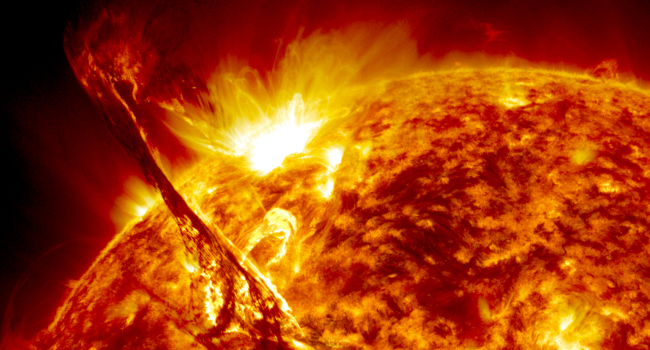
Experts from the Solar Astronomy Laboratory of the Space Research Institute (IKI) of the Russian Academy of Sciences have captured a unique phenomenon: a powerful X-class solar flare completely destroyed a giant solar prominence roughly 300,000 kilometers long — about three times the diameter of Earth.
In the released footage, magnetic structures from the flare’s epicenter can be seen “wrapping around and consuming” a cold gas cloud, then twisting violently before collapsing back into the Sun’s surface. This rare dynamic interaction, observed on November 9, 2025, vividly demonstrates how solar activity influences the star’s corona.
How the Flare “Devoured” the Prominence
Solar prominences are enormous filaments of cool, dense plasma suspended above the Sun’s surface by magnetic fields. They can stretch for hundreds of thousands of kilometers and appear as dark clouds against the bright solar corona. In this case, the prominence was located too close to an active region where the flare erupted — a massive burst of energy and radiation.
Footage from orbital observatories shows magnetic filaments shooting out from the X-flare’s center, wrapping around the prominence like tentacles. This interaction caused the partial destruction of the cloud and redistributed its plasma along the magnetic field lines.
The finale was dramatic: the remaining plasma, spinning rapidly, fell back into the solar atmosphere. The entire process lasted several hours — one of the clearest examples of such an interaction recorded in 2025.
Causes and Mechanism of Destruction
An X-class flare — one of the most powerful types — releases energy equivalent to billions of atomic bombs, heating plasma to millions of degrees and accelerating it along magnetic field lines.
The prominence, composed of relatively cool gas (10,000–20,000 K), cannot withstand this violent disruption. The pressure gradient and magnetic forces tear its structure apart.
“It’s like a shock wave engulfing a neighboring cloud,” explained researchers at IKI RAS.
This phenomenon occurred during the 25th solar cycle, currently at its peak activity. Earlier in 2025, scientists observed several black plasma ejections, but a complete destruction of a prominence remains extremely rare — a vivid illustration of the Sun’s complex magnetic dynamics.
Connection to Geomagnetic Storms on Earth
This event is not isolated. The November 9 flare was part of a sequence that began around November 5–6. Plasma from previous eruptions triggered a G2–G3 geomagnetic storm on November 8, and two new plasma clouds are now heading toward Earth.
According to IKI forecasts, moderate G2–G3 storms are expected in the coming days, with a possible increase to G4 by midweek.
Potential effects: auroras visible at mid-latitudes, interference with GPS and radio signals, and fluctuations in power grids. In Russia, auroras are likely to be visible across Siberia and the North.
Experts recommend that aviation and energy sectors monitor NOAA and IKI forecasts closely in the coming days.
Scientific Significance
The captured footage provides valuable data for modeling solar activity. It confirms theoretical predictions about flare–prominence interactions and helps improve forecasts of coronal mass ejections (CMEs) that affect space weather and Earth’s magnetosphere.
Upcoming missions such as Solar Orbiter and Aditya-L1 are expected to refine our understanding of these mechanisms — bringing us closer to predicting the Sun’s most powerful and unpredictable outbursts.