make preferable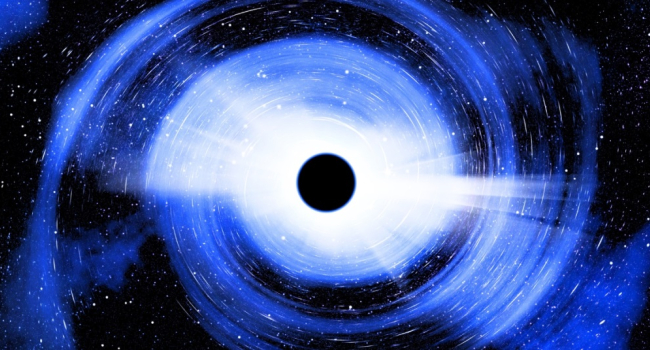
Astronomers have detected the brightest and most distant flare ever seen around a supermassive black hole, located 10 billion light-years from Earth. The flare, caused by the destruction of a massive star, released energy equivalent to 10 trillion Suns, surpassing all previously recorded events. The discovery, made using the Zwicky Transient Facility (ZTF), provides new insights into active galactic nuclei (AGN) and tidal disruption events (TDEs). The results were published on November 4, 2025, in Nature Astronomy.
What Happened — and How the Flare Formed
The flare occurred in the heart of galaxy J2245+3743, an active galactic nucleus containing a supermassive black hole about 500 million times the mass of the Sun. While the black hole typically feeds on gas and dust from its accretion disk, this event was a tidal disruption event (TDE) — when a 30-solar-mass star ventured too close and was torn apart by the black hole’s gravity.
It’s like a fish halfway swallowed by a whale, explained Matthew Graham, lead researcher at Caltech. The shredded remains of the star continue to fall into the black hole, powering the fading afterglow. ZTF first detected the flare in 2018, when its brightness increased fortyfold over a few months, peaking at a luminosity thirty times higher than any previously observed TDE, including 2020’s famous “Scary Barbie” event.
Distance and Time: 10 Billion Years Away, Moving in Slow Motion
Located 10 billion light-years from Earth, J2245+3743 is the most distant TDE ever discovered — a window into the early Universe. Due to cosmic expansion and the intense gravity of the black hole, time at the source appears stretched: seven years on Earth correspond to just two years there. “We’re watching it unfold at a quarter of its true speed,” Graham noted.
ZTF’s long-term monitoring — over seven years of observations — allowed astronomers to follow the flare’s entire evolution. Follow-up data from Keck Observatory (2023) and NASA’s WISE confirmed that the emission was not a supernova or a jet aimed at Earth — the energy was released in all directions.
Why It Matters
Tidal disruption events are extremely rare — only about 100 confirmed cases to date. Most occur around inactive black holes, while in active ones (AGN) they’re usually hidden by the bright accretion disk. J2245+3743 is a striking exception — its scale made it visible across the cosmos.
According to K. E. Saavik Ford (CUNY), in AGN disks, stars can actually grow by accreting matter — becoming much more massive before being destroyed.
This discovery suggests that TDEs may be far more common than we can currently detect, merely concealed by the glare of active galactic centers. The upcoming Rubin Observatory’s LSST is expected to find thousands of similar events, helping scientists understand how black holes feed and how galaxies evolve.
In Brief…
The most powerful tidal disruption event ever recorded occurred in galaxy J2245+3743, 10 billion light-years away, when a 30-solar-mass star was torn apart by a 500-million-solar-mass black hole. The flare’s luminosity reached 10 trillion Suns, making it 30 times brighter than “Scary Barbie.” First observed by ZTF in 2018 and confirmed by Keck, the event reveals time dilation effects (seen at one-quarter speed) and supports theories of star growth and destruction within AGN disks. The Rubin Observatory is expected to uncover many more such cosmic cataclysms.