make preferable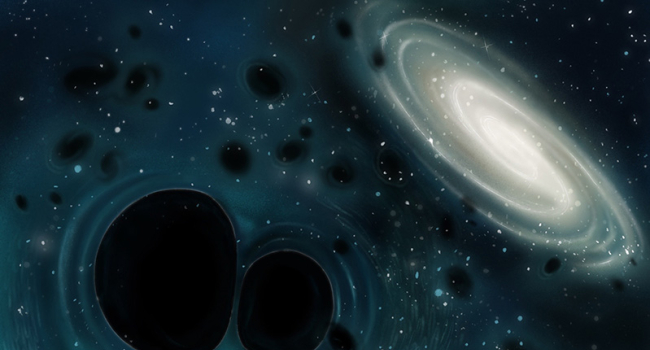
Scientists at the University of Geneva have confirmed that, on cosmological scales, dark matter behaves like ordinary matter, falling into the gravitational wells created by the curvature of spacetime. This discovery limits any potential fifth force of nature to less than 7% the strength of gravity — and may rule it out entirely. The findings, based on measurements of galaxy velocities and the depth of gravitational wells, were published on November 3, 2025, in Nature Communications.
Dark Matter: Invisible, But Gravitational
Dark matter makes up about 85% of the Universe’s total mass. It does not interact with light, but its gravitational influence is clear — it bends starlight, alters galaxy motions, and causes gravitational lensing. While its behavior is well studied within galaxies, its dynamics on scales of hundreds of millions of light-years have remained uncertain.
According to Einstein’s General Theory of Relativity, gravity arises from the curvature of spacetime caused by massive objects: the greater the mass, the deeper the “gravitational well.” The research team compared the speeds of galaxies with the depths of these wells. If dark matter responds only to gravity, galaxies — which consist mostly of dark matter — should fall just like ordinary (baryonic) matter. A fifth force would cause measurable deviations.
Method: Measuring Speed Against the Depth of the Well
Camille Bonvin (University of Geneva) explained:
“We compared the velocities of galaxies across the Universe with the depth of their gravitational wells. If no fifth force exists, their infall should match perfectly. If it does exist, galaxies would deviate.”
The team used data from DESI, Euclid, and SDSS, encompassing millions of galaxies, redshift measurements, and detailed maps of mass distribution. The result: dark matter falls into gravitational wells exactly like baryonic matter — with no deviations detected.
The Fifth Force: Constrained or Excluded?
According to Nastassia Grimm (University of Portsmouth), a fifth force isn’t entirely ruled out, but its effect must be less than 7% of gravity — otherwise, we’d have seen it.
This finding narrows the scope for alternative theories such as modified gravity models (MOND, f(R)) and self-interacting dark matter (SIDM) that invoke a new force. Upcoming observations from the LSST (Rubin Observatory) and DESI will push the detection limit down to 2% of gravity, said Isaac Toutousos (University of Toulouse):
“They will help reveal how dark matter truly behaves.”
Why It Matters for Cosmology
Dark matter has shaped the structure of the Universe — without it, galaxies would never have formed. Confirming its purely gravitational behavior strengthens the ΛCDM model, the current standard of cosmology. If a fifth force does exist, it must be extremely weak and short-range, with no effect on large-scale cosmic structures.
This discovery doesn’t close the door on new physics but sets tight constraints: dark matter behaves like ordinary matter under gravity.
In Short…
On cosmic scales, dark matter obeys gravity just like regular matter — falling into gravitational wells with no deviations observed. Any fifth force is limited to less than 7% of gravity’s strength; future LSST and DESI data could lower that limit to 2%. The discovery reinforces the ΛCDM model and narrows alternative theories. Dark matter remains a mystery — but now firmly within the bounds of known forces.