make preferable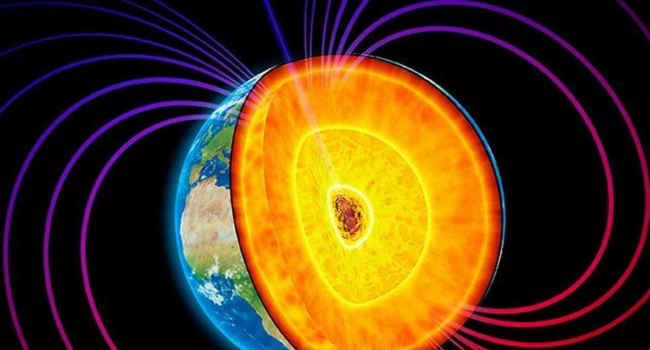
Scientists from Yale University have finally explained the mysterious magnetic anomalies found in rocks more than half a billion years old. It turns out they are not related to chaotic continental drift but to the formation of Earth’s core, which at that time had not yet reached its current stability. The results of the study were published in Nature Communications.
Ediacaran Magnetic Mysteries
The anomalies date back to the Ediacaran period — from 630 to 540 million years ago, just before the Cambrian explosion of life. In sedimentary and volcanic rocks from that time, magnetic minerals preserved traces indicating sharp shifts in the position of the magnetic poles. Previously, these were interpreted as signs of extremely rapid movement of lithospheric plates — up to several meters per year — which is geologically impossible. This hypothesis, known as “true polar wander,” suggested that Earth’s outer crust and mantle could have shifted relative to the planet’s rotational axis.
However, the new analysis showed that the changes occurred not over millions of years but within just a few thousand years. That is far too fast for plate tectonics, but it perfectly fits a scenario involving fluctuations in the magnetic field itself.
The Field Fluctuated, But Did Not Flip
By comparing data from volcanic rocks (which record the field instantly as lava cools) and sedimentary layers (which accumulate gradually), researchers determined that the average positions of the magnetic poles remained relatively stable. There were no catastrophic displacements or total chaos. The field maintained its overall structure but experienced strong fluctuations — with amplitudes reaching tens of degrees over short intervals.
This disproves the idea of a global sliding of the crust. Instead, scientists see the cause in the planet’s internal dynamics.
Core Formation as the Key Factor
During the Ediacaran period, Earth’s core had not yet completed crystallization. Today it consists of a solid inner core (iron and nickel) and a liquid outer core, where convection generates the magnetic field through the dynamo effect. Billions of years ago, this process was only gaining strength: lighter elements were being expelled from the center, causing unstable flows in the molten mantle.
Such internal rearrangements could temporarily weaken or distort the geodynamo, leading to magnetic anomalies. By the beginning of the Cambrian (about 540 million years ago), the core had stabilized, and the field became what we know today — with regular reversals but without chaotic swings.
Significance for Understanding Earth’s Evolution
The discovery fills a gap in paleomagnetic history and confirms that the magnetic field is a reliable indicator of the planet’s internal processes. It also explains why Ediacaran rocks show no signs of mass extinctions caused by the loss of protection: despite its fluctuations, the field still shielded the atmosphere from the solar wind.
In the future, such studies will help model the early Earth and identify analogies on exoplanets — where an unstable core may indicate planetary youth.
In Brief…
The magnetic anomalies of the Ediacaran period (630–540 million years ago) were caused not by plate movement but by field fluctuations due to the forming Earth’s core. Rock analysis showed rapid changes over thousands of years while the average poles remained stable. This disproves “true polar wander” and reveals a stage in the evolution of the geodynamo before the Cambrian explosion.