make preferable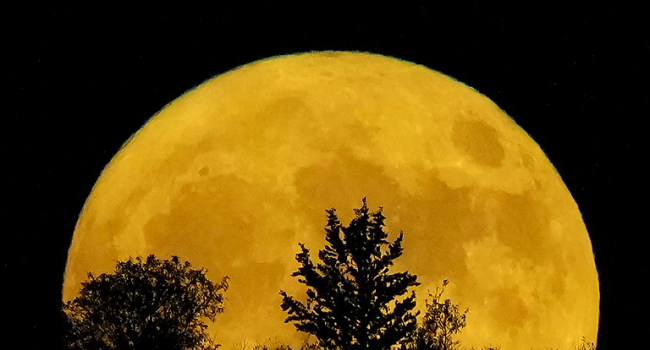
In 2025, astronomers predict two spectacular consecutive Supermoons—in November and December. This rare phenomenon occurs when a full Moon coincides with the moment it comes closest to Earth. According to the Moscow Planetarium, the first and brightest Supermoon of the year will take place on November 5, and the second exactly one month later, on December 5. On these nights, the Moon will appear noticeably larger and brighter than usual, creating a mesmerizing sight in the night sky.
The November 5 Supermoon: The Peak of the Year
The full Moon phase will occur on November 5 at 16:20 Moscow time (17:20 Yerevan time). The Moon will reach perigee—the closest point in its orbit to Earth—at 01:30 (02:30 Yerevan time) on November 6. At that moment, the distance between the centers of the Earth and Moon will be only 356,832 kilometers. This is the closest approach in all of 2025, about 50,000 kilometers closer than the average distance of 384,000 kilometers.
Because of this proximity, the lunar disk will appear about 8 percent larger and 16 percent brighter than during an ordinary full Moon. Evgeny Burmistrov, an expert from Perm Polytechnic University, explains that the “giant Moon” effect is especially noticeable near the horizon. This is an optical illusion: the brain compares the Moon to nearby objects such as houses or trees, making it seem larger.
The best time to observe the Supermoon is at moonrise or moonset, when it’s near the horizon. In Moscow and central Russia, this will occur around 17:00–18:00. For the clearest view, choose open locations outside the city, away from bright lights.
The Second Supermoon on December 5
Exactly one month later, nature will provide an encore. Perigee will occur on December 4 at 14:07 (15:07 Yerevan time), and the full Moon on December 5 at 02:15 Moscow time (03:15 Yerevan time). The distance will be 356,961 kilometers—just 129 kilometers farther than in November. The effect will be slightly weaker but still impressive: the Moon will remain 7–8 percent larger and noticeably brighter than an average full Moon.
In December, the Moon will be visible in the constellations Gemini and Taurus. In the European part of Russia, it will rise after 16:00–17:00 local time. Weather conditions at that time of year are often changeable, so it’s worth checking the forecast.
Why the Supermoon Looks So Striking
A Supermoon occurs because of the Moon’s elliptical orbit. At perigee, the Moon approaches Earth to about 356–357 thousand kilometers; at apogee, it recedes to 405–406 thousand. When a full Moon coincides with perigee within 12 hours, we see the maximum contrast. On average, such events happen three to four times per year, but two consecutive ones with nearly identical distances are a rare treat for observers.
Brightness increases according to the inverse-square law: a smaller distance yields more light. In addition, tides become stronger during a Supermoon—the ocean level can rise 10–15 centimeters above normal, particularly noticeable along coastlines.
How to Observe It Best
You don’t need complex equipment for a full experience. A pair of binoculars or a small telescope is enough to see craters and lunar seas on the surface. To photograph the Supermoon, use a tripod with a shutter speed of 1/100 second and ISO 400. Modern smartphones in night mode can handle it automatically.
The main requirement is a clear sky and a dark location. In cities, light pollution reduces contrast, so travel beyond urban areas. And remember: the “giant Moon” near the horizon is purely psychological—but no less enchanting for it.
In Short…
The brightest Supermoon of 2025 will occur on November 5: full Moon at 16:20, perigee at 01:30 on November 6, distance 356,832 km. The Moon will appear 8% larger and 16% brighter. The second Supermoon will follow on December 5: full Moon at 02:15, perigee on December 4, distance 356,961 km. Watch it at moonrise outside the city—the horizon illusion will enhance the view. Two Supermoons in a row are a rare gift from the sky.