make preferable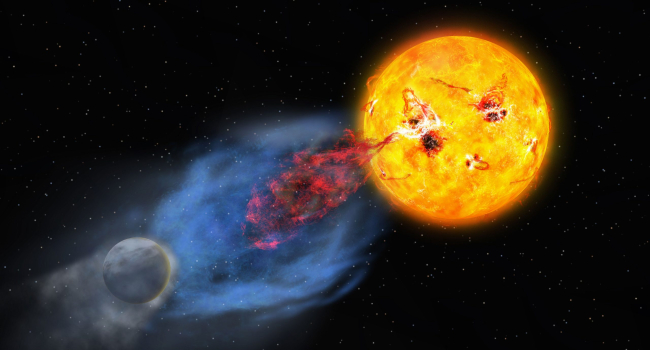
For the first time, an international team of astronomers has observed a massive coronal mass ejection (CME) from the surface of a star remarkably similar to what the Sun looked like in its youth. The discovery sheds new light on how the Sun’s intense activity billions of years ago may have triggered the chemical reactions that led to the origin of life on Earth. The findings were published in Nature Astronomy.
A Glimpse into the Early Solar System
“We wanted to understand how the flares and eruptions of the young Sun affected the newborn Earth,” explains Kosuke Namekata, the lead author of the study. “Simultaneous observations from orbital and ground-based telescopes in Japan, Korea, and the U.S. allowed us to look back into an era when our Sun was only about 100 million years old.”
The target of their study, EK Draconis, lies about 110 light-years away and is considered a near-twin of the Sun at an early stage of its evolution.
The First Observation of a Multi-Temperature CME
The team combined data from:
• The Hubble Space Telescope (capturing ultraviolet radiation from hot plasma);
• Ground-based observatories in Japan and Korea (covering visible and infrared wavelengths).
For the first time, they detected a multi-temperature coronal mass ejection, consisting of:
• A hot plasma burst (millions of degrees) traveling at 300–550 km/s;
• A cooler flow following about 10 minutes later, moving at ~70 km/s;
• A hot phase carrying tens of times more energy than the cooler one.
How Solar Fury Could Have Sparked Life
Such violent eruptions from the young Sun would have produced:
• Powerful shock waves, and
• Streams of high-energy particles (protons and electrons).
According to modern models, these energetic particles could have:
• Broken apart atmospheric molecules on early Earth;
• Driven the synthesis of complex organic compounds;
• Helped form greenhouse gases that trapped heat and stabilized the planet’s climate.
“Coronal mass ejections were likely a key catalyst of prebiotic chemistry,” Namekata emphasizes.
In Brief
Astronomers have observed the first multi-temperature coronal mass ejection from EK Draconis, a young solar analog. The hot plasma, erupting at up to 550 km/s, carried enough energy to initiate biomolecular synthesis on early Earth.
This finding suggests that stellar activity—not just the presence of liquid water—may be an essential factor for planetary habitability. In other words, life might owe its origin not only to calm conditions, but also to the cosmic storms of a restless young Sun.