make preferable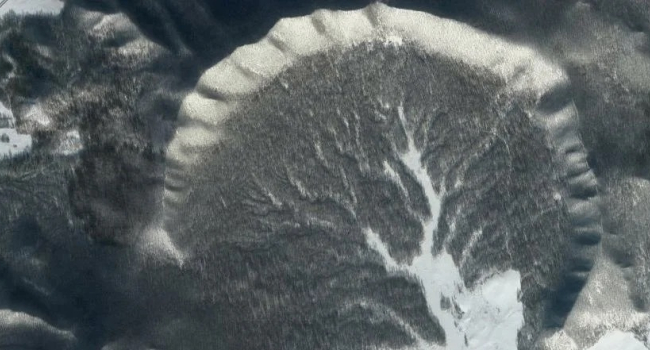
Chinese geologists in the country’s south have found compelling evidence of a massive asteroid impact that occurred roughly 10,000 years ago, during the rise of early human settlements. The discovery was reported by the South China Morning Post (SCMP).
A new addition to China’s impact sites
The newly identified structure, named Jinlin, is located near Zhaoqing City in Guangdong Province. It is the fifth officially confirmed asteroid-impact crater in China — and notably, the first ever discovered in the country’s southern regions.
The scale of the catastrophe
The formation resembles a tilted bowl with an estimated diameter of about 900 meters. Experts believe it was created by a meteorite roughly 30 meters wide, releasing an impact energy equivalent to 600,000 tons of TNT — about 40 times more powerful than the atomic bomb that destroyed Hiroshima.
The strike drastically reshaped the local landscape and caused widespread destruction of plant and animal life for several kilometers around the impact site.
Geological evidence and ongoing studies
To confirm the crater’s extraterrestrial origin, geologists analyzed quartz rock samples from the site. They found microscopic glassy lamellae, structures that form only under extreme pressure and temperature — conditions produced exclusively by high-velocity cosmic impacts.
Researchers are now working to precisely date the formation and conduct a comprehensive geomorphological analysis, studying erosion patterns and sediment accumulation to better understand its evolution over millennia.
In brief
In Guangdong Province, China has identified the Jinlin Crater, left by a 30-meter asteroid that struck the Earth 10,000 years ago with the force of 40 atomic bombs. It is the first confirmed impact site in southern China, verified through distinctive quartz glass structures. Scientists continue to refine its age and examine its geological features.