make preferable
Dark matter — the elusive substance that has mass but completely ignores light — remains one of the central mysteries of cosmology. An international team of physicists has developed an innovative method to detect it by analyzing subtle distortions in the spectrum of light from distant galaxies. The study was published in Physics Letters B (PLB).
Why ordinary particles don’t fit the role
Neutrinos, the well-known “ghost particles,” partially fit the description of dark matter but are too light and move too fast to account for the gravitational behavior of galaxies and the large-scale structure of the Universe. The main candidates remain WIMPs (Weakly Interacting Massive Particles). Their hypothesized mass makes them impossible to produce in particle accelerators, but their rare collisions could, in theory, generate high-energy gamma rays.
Direct searches for such signals have so far been unsuccessful. The new approach reverses the strategy: instead of hunting for dark matter particles themselves, scientists suggest studying indirect traces of their influence on light traveling through space.
How dark matter “colors” photons
The researchers simulated how background radiation interacts with two types of dark matter:
- Purely gravitational dark matter — which does not interact with ordinary matter except through gravity.
- Weakly interacting dark matter — which allows rare collisions between its own particles.
The results were unexpected: the scattering pattern of photons depends on the type of dark matter involved.
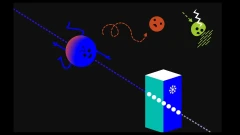
- Under gravitational dominance, photons tend to scatter forward, gaining slight acceleration and acquiring a bluish tint.
- In the weakly interacting case, scattering occurs backward — photons lose energy and exhibit a reddish shift.
First tests using Fermi-LAT data
The scientists compared their models with observations from NASA’s Fermi-LAT gamma-ray telescope, which monitors the center of the Milky Way. So far, the data are consistent with both scenarios but do not allow a definitive conclusion. Future missions with more advanced spectral precision could detect these subtle effects and determine which model is correct.
The promise of indirect astronomy
If confirmed, the effect would provide humanity with a fundamentally new tool: dark matter could be “seen” not through collision detectors, but through microscopic color shifts in light that has traveled billions of light-years.
In summary
Researchers propose detecting dark matter by the color tint of light from distant galaxies — a blue shift would indicate gravitational influence, while a red shift would point to weak interactions. Initial tests using Fermi-LAT data are consistent with the models, and upcoming telescopes may finally reveal which type of dark matter shapes the Universe.