make preferable
Dark matter, which makes up more than 80 percent of the Universe’s total mass, remains one of the greatest cosmic mysteries. It neither emits, absorbs, nor reflects light, making it invisible. However, a new study by researchers at the University of York (UK), published in Physics Letters B, suggests that light passing through regions rich in dark matter may acquire a faint tint — red or blue — depending on the type of dark matter present. The findings were reported by Space.com.
Colorful “fingerprints” of light
The effect is so subtle that current telescopes cannot detect it, but future ultra-sensitive observatories — such as the European Extremely Large Telescope and NASA’s Nancy Grace Roman Space Telescope — may be capable of doing so. Co-author Mikhail Bashkanov from the University of York noted that this question is unusual for science, since everyone agrees that dark matter is “dark.” Yet, he explained, their work shows that even the darkest matter might possess a color signature.
Researchers compare the phenomenon to the “six degrees of separation” principle, which states that any two people on Earth are connected through no more than six acquaintances. Similarly, dark matter, which does not interact directly with light, could do so indirectly through intermediaries such as the Higgs boson — the so-called “God particle” responsible for giving mass to other particles. This indirect interaction allows photons (particles of light) to scatter slightly off dark matter particles, leaving behind a color or polarization imprint.
Red or blue: what the color shift reveals about dark matter
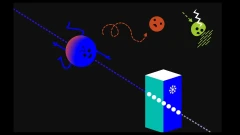
Bashkanov and his team have produced the first detailed calculations of how much light can scatter off dark matter. If dark matter is composed of WIMPs (Weakly Interacting Massive Particles) that interact via the weak nuclear force, light passing through WIMP-rich regions would lose some of its high-energy blue photons, producing a reddish tint. If, on the other hand, dark matter interacts only through gravity, the scattering would cause a slight blue shift.
These effects are minute but not zero, and they could appear in dense regions such as galactic centers or clusters of galaxies. Such color “fingerprints” might slightly distort the light spectrum of distant objects — for instance, making the glow of a galaxy appear a bit redder or bluer depending on the type of dark matter lying along the line of sight. This, in turn, could help astronomers distinguish between competing dark matter models — WIMP-based or purely gravitational — by analyzing color shifts in the light.
Why it matters
Bashkanov emphasized that billions have been spent on experiments searching for WIMPs, axions, or dark photons. Their results, he said, point to where and how to look in the sky, potentially saving valuable time and resources. Detecting these shifts will require extremely precise telescopes and the analysis of light that has traveled billions of light-years.
If this hypothesis is confirmed, it could open a new window into the study of dark matter, bringing scientists closer to solving one of cosmology’s deepest mysteries.
In summary
Dark matter — normally invisible to light — may leave subtle red or blue “fingerprints” on photons passing through dense regions of the Universe. The effect depends on its nature: WIMP-based dark matter produces a red shift, while gravity-only dark matter causes a blue one. Though the effect is faint, next-generation telescopes such as the Roman Space Telescope may be able to detect it, offering a new path toward understanding the 80 percent of the Universe that remains unseen.