make preferable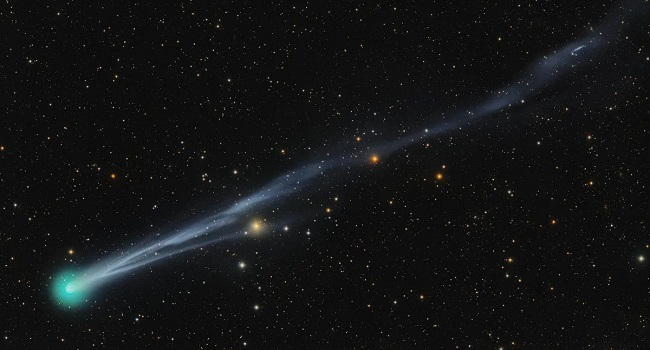
Comet Lemmon (C/2025 A6) is rapidly increasing in brightness as it approaches the Sun and Earth, already turning into an impressive celestial body visible through small telescopes and binoculars. Soon, it may even become visible to the naked eye. Discovered on January 3, 2025, during the Mount Lemmon Survey in Arizona, this icy visitor is the brightest comet in our sky since January 2025, when C/2024 G3 (ATLAS) shone. On November 8, it will reach perihelion—the closest point to the Sun—at a distance of about 79.25 million kilometers. Currently visible in the pre-dawn sky, the comet is evolving quickly, and astronomers around the world are preparing for its peak in late October.
A Rare Sight: Brightness and Predictability
Usually, several comets appear each year that are visible through binoculars or small telescopes, but only once every 5–10 years does one become bright enough for the naked eye. According to optimistic forecasts, by the end of October, Comet Lemmon could reach a magnitude of +3—similar to the star Megrez in Ursa Major. This offers a rare opportunity for skywatchers. Unlike sharp-pointed stars, comets appear as blurred smudges. Back in 1974, National Geographic’s Kenneth Weaver described a similar comet, Kohoutek, as resembling a giant brush dipped in white paint and swept across the black sky, leaving a ghostly streak above a glowing core. However, light pollution today poses a serious obstacle: in the United States, about 80% of the population lives in areas where stars are barely visible. For the best experience, observers are advised to seek dark locations where the Milky Way can be seen.
An Active Comet: Changes and Approach
Comet Lemmon is unusually active—its appearance changes almost daily. Throughout October, it will continue to brighten and grow, reaching perigee on October 21 at a distance of 89.2 million kilometers from Earth. Its brightness, color, and tail shape depend on its orbit, angle, and nucleus composition—a mix of ice, dust, and rock similar to Saturn’s rings. As sunlight heats the comet, the ice sublimates, releasing gas and dust that form the tail. Lemmon’s tail is primarily gaseous, bluish, and straight, extending away from the Sun. Dust tails tend to be brighter, but gas dominates in this case. Astronomers have noted that despite the full Moon on October 6, the comet remains easy to spot in binoculars. According to data from the Comet Observation Database (COBS) as of October 6, its brightness was +6.1, its coma (head) measured 8 arcminutes (a quarter of the Moon’s diameter), and its tail spanned one degree (twice the Moon’s apparent width)—though images reveal an even longer structure.
How to Observe: Morning and Evening
At present, the comet is a morning object, best viewed about 90 minutes before sunrise in the southern part of Ursa Major. British Astronomical Association member Nick James remarked that the comet was developing beautifully and already looked impressive in the morning sky. While the full Moon had reduced visibility earlier, the sky would darken after the last quarter on October 13. October 16 would be a particularly good date for observation, as the comet would appear just one degree above Cor Caroli (+2.8 magnitude) in Canes Venatici. To find it, observers should locate the Big Dipper in the northeast, draw a line from Dubhe through Phecda, and extend it twice the distance downward—there lies Cor Caroli. Aiming binoculars at the star should reveal the comet just above it.
On October 16, the comet will transition into the evening sky, with the best viewing period expected between October 22 and 28, low in the west-northwest after twilight. On October 24, it will pass from Boötes into Serpens at an altitude of about 15 degrees (roughly the width of one and a half fists held at arm’s length). On October 22, it will be two degrees left of Izar (Pulcherrima), a striking double star with yellow and blue hues. The waxing crescent Moon will not interfere with observations. Japanese expert Seiichi Yoshida has predicted a brightness of +4, while Dutch astronomer Gideon van Buitenen has forecast +3.3, suggesting it may become visible to the naked eye under dark skies. Nick James added that it should become an excellent evening object near the new Moon at the end of October.
Conclusion: Don’t Miss the Chance
Under dark-sky conditions, the comet will remain visible through early November. As with all comets, its behavior is unpredictable—it might fade or flare suddenly. For now, it is performing well, promising a rewarding show for observers in the Northern Hemisphere. Darkness will be key to success: during the second and third weeks of October, when the Moon is absent, viewing conditions will be ideal.
In brief
Comet Lemmon (C/2025 A6), the brightest since January 2025, may become visible to the naked eye (+3–4 magnitude) in late October. It will appear below Ursa Major until October 16 and move into Boötes from October 22–28. Its closest approach to Earth will occur on October 21. Observers are encouraged to head to dark areas—the spectacle will be worth it.