make preferable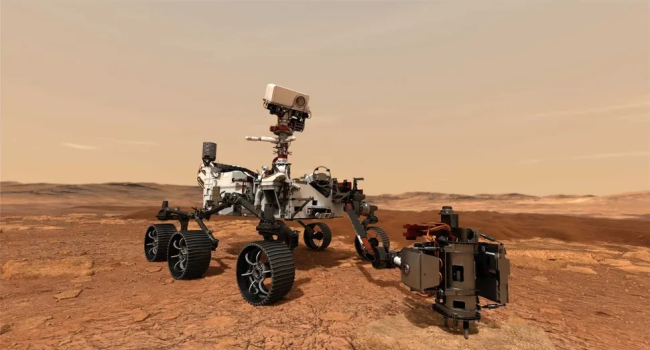
NASA’s Perseverance rover has detected a potential biosignature in Jezero Crater—traces that may point to ancient microbial life. The finding concerns a sedimentary rock nicknamed Cheyava Falls, discovered in July 2024 in an ancient river delta. On the red stone, scientists observed light spots surrounded by darker rings, the so-called “leopard spots,” which are similar to formations seen on Earth.
The rock is rich in hematite—an iron oxide that forms in liquid water—as well as the minerals vivianite (iron phosphate) and greigite (iron sulfide), which on Earth serve as energy sources for microbes. In addition, clay sediments contain organic material (carbon-based molecules), though its exact type has not yet been determined. The sample has already been collected and stored for a future return to Earth.
Oleg Abramov of the Planetary Science Institute told Space.com that these may be the strongest evidence of microbial life on early Mars so far. However, he stressed that this is not proof of life, but rather a reason to continue investigations.
Why This Is Exciting—but Not a Sensation
The discovery has stirred the scientific community: according to Nature (September 10, 2025), this is the strongest candidate for a biosignature in the history of Martian astrobiology. Unlike more abstract signals such as atmospheric gases, here the combination of organics, minerals, and textures almost always indicates life on Earth. Importantly, there are no signs of high temperatures or acidity that could provide a non-biological explanation for the markings.
On social media and in the press, the reaction has been enthusiastic: NASA’s post drew 37,000 likes, while scientists and space enthusiasts debated what this means for Mars’s habitability. Still, experts emphasized that without laboratory analysis on Earth—using microscopes and spectrometers—the evidence remains only “potential.” The rock’s age, between 3.2 and 3.8 billion years, also complicates interpretation since biological traces may have degraded.
Comparing Past “Life on Mars” Announcements
This is not the first time Mars has been linked to hints of life, but previous cases caused more hype and disappointment:
- Meteorite ALH84001 (1996): Claimed to contain minerals and “microfossils” from Mars, found in Antarctica. Even President Bill Clinton announced it. Later research suggested non-biological processes or terrestrial contamination. Abramov called it “overhyped, but not disproven.”
- Methane releases (since 2003): Detected by telescopes, Mars Express, Curiosity, and the Trace Gas Orbiter. Since methane breaks down under UV radiation, its replenishment suggests a source. On Earth, it usually comes from life, but on Mars it may result from serpentinization (reactions of water with rock). Abramov described it as “intriguing, but ambiguous.”
The new discovery is stronger: it is contextual (a river delta), involves both organics and minerals, and is not being hyped in the same way as ALH84001. Lessons from the past have made the community more cautious.
Biosignatures Beyond Mars: Venus and Exoplanets
The search for life is broader:
- Phosphine on Venus (2020): A gas that on Earth comes only from life, detected in the planet’s clouds, where conditions resemble Earth’s. But data remain controversial; many studies do not confirm it. New missions are awaited (NASA’s is threatened by budget cuts, ESA’s EnVision is scheduled for 2031).
- Dimethyl sulfide on K2-18b (2023): An ocean exoplanet where JWST detected a potential biosignature. Models suggest a “Hycean world” (a hydrogen atmosphere with an ocean), but the signal is at the edge of the telescope’s sensitivity. Confirmation requires a more powerful instrument.
The Martian case is more convincing: the sample is already in hand. However, the Mars Sample Return program is in jeopardy because of the Trump 2026 budget, and China may overtake the U.S. with its own mission.
What’s Next: Sample Return and Scientific Lessons
Perseverance has already cached the sample for Mars Sample Return, but the mission is struggling with cost overruns and delays. NASA is seeking help from private partners, though the program is under threat of cuts. Abramov emphasized that returning the samples to Earth is the best chance to understand them fully.
He noted that “we are getting closer to the truth, but not always reaching it,” adding that the discovery could extend Mars’s “window of habitability.” Still, to reach a true “Eureka” moment, scientists need to identify microfossils in Earth-based laboratories.
In Brief…
The discovery of Cheyava Falls is the strongest biosignature found on Mars: a combination of organics and minerals resembling Earth’s microbial traces, located in an ancient river delta. Stronger than ALH84001 or methane signals, but not proof—laboratory analysis on Earth is required. The Mars Sample Return mission is under financial threat, and China may get there first. Be excited: this is a major step toward finding life beyond Earth—but be cautious, because science teaches patience.