make preferable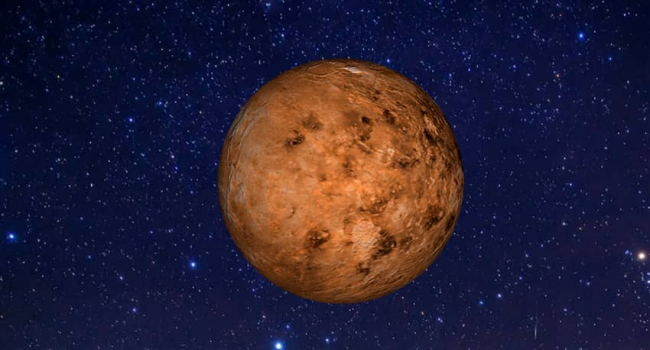
Asteroids hiding in the vicinity of Venus may become an unexpected danger for Earth. Brazilian astronomers from São Paulo State University (UNESP) have identified entire families of such objects that are almost impossible to detect from our planet. In a few thousand years, they could approach Earth and even collide with it. The study, published in the journal Astronomy & Astrophysics (A&A), emphasizes the urgent need for monitoring.
“Co-orbital” Asteroids: Venus’s Invisible Neighbors
Asteroids that share an orbit with Venus—so-called co-orbital asteroids—are unlike the stable Trojan asteroids of Jupiter. Their orbits are elongated and chaotic, subject to disturbances from Venus and the Sun. Every 12,000 years they shift from a safe configuration to a dangerous one, where they may approach Earth.
“We discovered a population of potentially hazardous asteroids that we cannot currently see. They are not in the main belt between Mars and Jupiter, but much closer—near Venus. Their position makes them invisible, but in the future, they could threaten Earth,” explained lead author Valerio Carruba, professor at UNESP.
So far, only 20 such asteroids are known, 19 of which have an eccentricity greater than 0.38. Orbital modeling over 36,000 years showed that they can approach Earth at minimal distances.
Why Can’t We See Them?
These asteroids are hard to reach with telescopes: they always stay close to the Sun, visible only for 1–2 weeks and only when they rise above 20° on the horizon. Even the powerful Vera Rubin Observatory in Chile, launched in 2025, will not be able to find them.
Asteroids 300 meters in diameter can create craters up to 4.5 kilometers wide, releasing energy in the hundreds of megatons—thousands of times more powerful than the bombs of 1945. An impact in a populated area would be catastrophic.
Solutions: Detection and Deflection
Scientists propose:
- Telescope deployment: at the Lagrange points L1/L2 of the Sun–Venus system for constant monitoring.
- Missions: NASA’s NEO Surveyor and China’s Crown for detection and cataloging.
For protection, the solution is deflection: altering an asteroid’s orbit. Early detection would make it possible to use a kinetic impactor or even a nuclear charge, though international policy currently bans weapons in space.
“Planetary defense must account not only for what is known, but also for what is hidden,” concluded Carruba.
In Short…
Venus’s co-orbital asteroids are an invisible threat that could approach Earth in millennia. Their chaotic orbits and closeness to the Sun make them difficult to detect. The UNESP study calls for urgent reconnaissance to prevent catastrophe. It is a reminder that space is full of surprises—and our safety depends on vigilance.